Publications
What next in Armenia – Azerbaijan relations  By Benyamin Poghosyan, PhD, Chairman, Center for Political and Economic Strategic Studies
More than one year after the 2020 Artsakh War, the future of Armenia–Azerbaijan relations remains vague. Azerbaijan has put forward two demands: Armenia in written form should recognize Nagorno Karabakh as part of Azerbaijan and provide uncontrolled access to Azerbaijan to reach the Nakhichevan Autonomous Republic via the Syunik province. Simultaneously, Azerbaijan has launched the strategy of coercive diplomacy and military blackmail, refusing to free all remaining Armenian POWs and advancing into Armenian territory. The release of POWs is a clearly articulated agreement fixed in the November 10, 2020 trilateral statement. However, Azerbaijan argues that Armenians still languishing in Azerbaijani jails are POWs and are not covered by that statement. Baku successfully merged the POWs’ issue with maps of mine fields, thus forcing Armenia to accept the humans versus maps bargain. READ MORE
Publications
Georgia’s Thorny Path to NATO 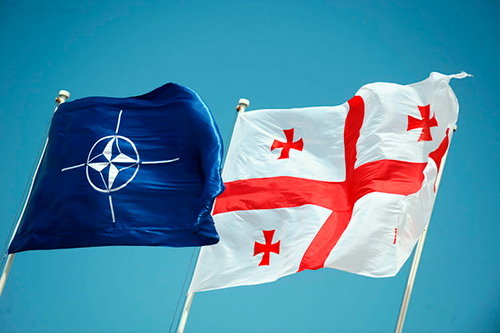 Eugene Kogan, Tbilisi-based defence and security expert
Amid heightened tensions between the U.S. and Russia over Ukraine, the issue of Georgia’s path to NATO membership is once again in the spotlight. While Tbilisi has made real progress in its military reform efforts, the major hurdle is political, not military, in nature and until the Alliance can achieve consensus, the future of Georgia’s relationship with NATO will remain uncertain. In March 2019, then-Georgian Defence Minister Levan Izoria heralded a new era in military reform: “In the past we trained our soldiers for external deployment, but the new emphasis is now on self-defence” — or rather territorial defence, a process that began to be addressed by U.S.-based military advisers in July 2016. READ MORE.
Publications
Successful Border Demarcation and Delimitation Process Crucial for a Final Peace Agreement
 By Fuad Shahbazov, Baku-based independent regional security and defence analyst
The current border tensions between Azerbaijan and Armenia are not the first and likely not the last. Given this, a successful border demarcation/delimitation process could be a crucial point in paving the way for a final peace agreement between the two adversaries. Therefore, the resumption of direct peace talks is the only rational option.
Last month, shortly after the first anniversary of the 44-day Karabakh war between Azerbaijan and Armenia, saw a new phase of violent hostilities, and the fighting was far from conventional. Deadly skirmishes occurred on the Azerbaijan–Armenia's international border, in a place named Giziltapa (Tsitserrnakar) near Syunik province. According to the Ministry of Defence of Azerbaijan, the tensions flared up due to the Armenian Armed Forces' intensive artillery fires at the positions of the Azerbaijani Armed Forces. In response, the Armenian Ministry of Defence accused the Azerbaijani side of provocation, violating international borders, and spreading disinformation regarding the skirmishes. READ MORE
Publications
Risks and Opportunities of the Emerging South Caucasus Regional Order 
 Policy Recommendations from the 21st workshop of RSSC SG/PfP Consortium
The Regional Stability in the South Caucasus Study Group (RSSC SG) was proud to resume its activities in a face-to face format in Rome, 7-10 September 2021. On that occasion, the Study Group discussed and subsequently agreed on a number of policy recommendations.
The second Karabakh war was the catalyst for massive changes in the South Caucasus. Certainly, the new territorial realities fit better the internationally recognized territories of both countries, but important challenges remain, making it important for the RSSC SG to meet to spur thinking on the way forward. The conflict was also an opportunity for other regional actors. Georgia deployed uncommon diplomacy and peace-making skills in the aftermath of the combat phase between Armenia and Azerbaijan. While Georgia demonstrated its ability at being an effective bridge between the two belligerents, Russia established itself as the essential arbiter and guarantor of a fragile ceasefire, and of purveyor of security for new lines of demarcation between Armenia and Azerbaijan. Turkey has not waited and sided with Azerbaijan in achieving and securing the new territorial realities. READ MORE
Publications
"Summit of Democracy" Puts Smaller States in a Complicated Situation By Benyamin Poghosyan, PhD, Chairman, Center for Political and Economic Strategic Studies
Regardless of the intentions of the US and the future trajectory of the new world order transformation, the democracy vs. authoritarianism vision puts small states located between Russia and Europe in a complicated situation.
As the "Unipolar Moment" started to fade away after the 2008 world financial crisis, political elites, the expert community, and academicians in the different capitals of the world launched discussions and debates about the future of the world order. There was no lack of catchy terms – post-American world, multi-polar world, no polar world, polycentric world, the rise of others – which all have one common feature; there will be many players active on the geopolitical chessboard of the globe, and the US will not be able to impose its vision on all of them. The US political establishment coined its term for the emerging world order – great power competition – which is the prevailing theme in all strategic level documents published by the Trump and Biden administrations. READ MORE
1
...
159
160
161
...
1271