The Port of Baku Facilitates Trans-Eurasian Commerce (Part 2)[Over]  By Vusal GULIYEV, Policy Advisor at the Center of Analysis of International Relations and Head of Shanghai Office at AZEGLOB Consulting Group By Vusal GULIYEV, Policy Advisor at the Center of Analysis of International Relations and Head of Shanghai Office at AZEGLOB Consulting Group
Azerbaijan is embarking on ambitious reforms and collaborations within its transport and logistics sector, driven by the opportunities presented by the Middle Corridor trade route. Initiatives such as the integration of Azerbaijan’s railway and port systems and the establishment of international partnerships signal a push toward greater efficiency and connectivity in trade infrastructure. On April 25, Azerbaijani Foreign Minister Jeyhun Bayramov, during a press conference with Kaja Kallas, EU High Representative for Foreign Affairs and Security Policy, stated that work is underway to increase the cargo capacity at the Port of Baku from 15 million tons to 25 million tons. Efforts such this underscore Baku’s vision of transforming the country into a critical node of global trade routes, reinforcing regional connectivity and contributing to economic diversification READ MORE
The Port of Baku Facilitates Trans-Eurasian Commerce[Over] By Vusal GULIYEV, Policy Advisor at the Center of Analysis of International Relations and Head of Shanghai Office at AZEGLOB Consulting Group
In December 2024, Azerbaijani President Ilham Aliyev authorized a $12 million investment into the Port of Baku to initiate the second phase of its expansion. This phase aims to increase the port’s annual cargo capacity from 15 million to 25 million tons. The region’s ongoing geopolitical instability, largely due to Russia’s full-scale invasion of Ukraine and the ensuing Western sanctions, has disrupted its established trade routes. These geopolitical upheavals underline the importance of Azerbaijan’s position between Europe and Asia as a transit state via the Port of Baku. Azerbaijan’s flagship port is capitalizing on its strategic location along the Silk Road to become a key hub for east–west connectivity. READ MORE
Azerbaijan’s Contribution to Regional Connectivity[Over] By Vusal GULIYEV, Head of Shanghai Office at AZEGLOB Consulting Group and Policy Expert at the Baku-based Topchubashov Center
Azerbaijan is transforming into a key regional hub through strategic investments in transportation infrastructure, particularly along the Middle Corridor. Expanding rail, maritime, and digital connectivity, the country enhances trade between Europe and Asia. Projects like the Baku-Tbilisi-Kars railway and Port of Baku solidify Azerbaijan’s role in global logistics and economic diversification.
Azerbaijan’s focus on improving transportation infrastructure has been central to its role in enhancing regional connectivity, especially in the broader context of linking Europe and Asia. As part of the effort to revive the historic Silk Road, significant progress has been made in expanding trade and transportation networks—particularly rail and maritime routes that facilitate intercontinental trade along the east-west corridor. This expansion is a critical aspect of Baku’s long-term socio-economic growth strategy. Azerbaijan has consistently prioritized unlocking the trade potential of the Trans-Caspian routes, investing in advanced logistics and transportation infrastructure, including rail lines, highways, and seaports, supported by both domestic and international development initiatives. READ MORE
- February 22, 2025 22:53PM
The Emerging Azerbaijan-Gulf Partnership in Energy[Over]
 By Fuad Shahbazov, Baku-based independent regional security and defence analyst By Fuad Shahbazov, Baku-based independent regional security and defence analyst
On January 8, Mohammad bin Zayed Al-Nahyan (MBZ), the leader of the United Arab Emirates (UAE), paid an official visit to Azerbaijan upon the invitation of his counterpart, President Ilham Aliyev. While MBZ’s visit to Baku signaled an era of deepening economic and energy ties between Azerbaijan and the UAE, it also reflected significant progress made in recent years. Indeed, the bilateral relationship has seen a raft of new projects and investments, particularly in the renewable energy sector. Notably, according to 2022 data, the Gulf countries are now among Azerbaijan’s top investment partners, though reciprocal investment remains low, compared to Azerbaijan’s other partners. READ MORE
Geopolitical Change and the Re-Emergence of the Middle Corridor[Over]
By Fuad SHAHBAZOV, Baku-based independent regional security and defence analyst
As the war in Ukraine escalates and becomes more violent, global food and energy recession risks continue to increase, in turn further heightening the likelihood of a global economic recession. The new full-scale war revealed particular vulnerabilities of the Western block of countries, particularly on energy and supply chain management, due to their imposition of sanctions and export restrictions on Russia. Hence, new security challenges in Europe have forced the Western block of countries to explore new and safer trade routes while avoiding Russian territory. With the West’s search for new and safer trade routes, the Middle Corridor—a joint venture composed of Azerbaijan, Georgia, Kazakhstan, and Türkiye—has regained strategic prominence. READ MORE
- November 19, 2022 06:23AM
Oil Market Collapse Damages the Iraqi Economy[Over]  By Ahmed Mousa Jiyad, Development Consultancy & Research, Norway By Ahmed Mousa Jiyad, Development Consultancy & Research, Norway
The collapse of the global oil market is undoubtedly unprecedented in its timing, magnitude, spread and devastating impacts across the globe. A strange and unpredicted association of a few, but major, factors had contributed to the current threat, causing much uncertainty and vulnerability on national and global levels. The revised "OPEC+" production cut agreed on 12 April prompted initial minor improvement in oil price, but there remains very many serious concerns that such reduction is much below what is needed to bring stability to and balances a saturated global oil market. READ MORE
- September 30, 2020 11:10AM
Armenia caught in a peculiar transit trap[Over]  By Benyamin Poghosyan, PhD, Executive Director, Political Science Association of Armenia By Benyamin Poghosyan, PhD, Executive Director, Political Science Association of Armenia
The South Caucasus is facing an infrastructure development boom. However, Armenia is in stark isolation, with no major project passing through the country.
The launch of new transit routes and transport infrastructure are key topics widely discussed within the context of the geopolitics of the South Caucasus. Since the late 1990s several new pipelines, highways and railroads have been constructed traversing the region. Given the re-emergence of Russia as a key player in the post-Soviet space, since President Putin's ascendance to power in 2000, new transport corridors and large infrastructure projects have become factors in the wider competition between Russia and western countries. READ MORE
- February 27, 2018 15:18PM
Russian Defence Industry in the Era of Putin[Over] 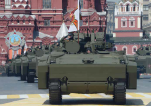 By Eugene Kogan, Tbilisi-based defence and security expert By Eugene Kogan, Tbilisi-based defence and security expert
There is a preconceived and very inaccurate perception in the West at large that the Russian Military-Industrial Complex (MIC) has and will continue to have difficulties in the coming years because Russia faces domestic economic challenges caused by the low price of oil, continuing economic sanctions imposed by the EU and the US and the breakdown of defence industrial relations with Ukraine.
There is very little understanding in the West that for President Vladimir Putin the issue of rearmament and well-functioning of the MIC are of crucial importance, and that the Russian president is not ready to give up an inch in tenaciously pursuing this ambitious items on his domestic agenda. READ MORE
- December 18, 2017 22:09PM
Post-Revolution Tunisia: Still Waiting for Economic Recovery[Over]  by Naim Ameur by Naim Ameur
Expert on political transition in Tunisia and the Maghreb
One year after the Jasmine Revolution of January 14, 2011, Tunisia has successfully advanced in its democratic transition and political reform process. The election of the National Constituent Assembly (NCA) held on October 23, 2011 was well organised, and for the first time in history, it was fair. Al-Nahdha (which means “renaissance” in Arabic), a moderate Islamic party, won 41 per cent of the NCA seats. READ MORE
The EU-Russia Energy Partnership: Overcoming the Challenges[Over] The energy trade between Russia and the countries of the European Union (EU) is of fundamental significance for the energy security of each party. Despite the close proximity of the EU-Russia energy relationship, however, the legal and political basis underpinning this relationship, particularly with regards to the gas trade, has proven itself inadequate in guaranteeing the energy security of both parties. Russia's recent announcement of its intention "of not becoming a member" of the Energy Charter Treaty, and new proposal for global energy security has created further uncertainty. While it is hoped that a new government in Kiev will lead to an improvement of Russian relations with Ukraine, Ukraine's national gas transportation operator remains in a difficult financial position and another gas crisis embroiling Ukraine, Russia and the EU, whilst hardly imminent, cannot be entirely ruled out.
Leading Russian and international energy professionals have shared their views on these energy policy challenges in an online session. Click here to go into the discussions or here to view forum summary
|
|




 Archive