From Syria to Nagorno-Karabakh: Assessing Russo-Turkish ‘Co-opetition’  By Yeghia TASHJIAN, Beirut-based regional analyst and researcher, columnist, "The Armenian Weekly” By Yeghia TASHJIAN, Beirut-based regional analyst and researcher, columnist, "The Armenian Weekly”
On a diplomatic level, Turkey tried to launch “Astana style” diplomatic measures to address Nagorno-Karabakh. However, given the fact that the conflict was taking place in the post-Soviet space, Russia failed to see much incentive in engaging in a bilateral track with Turkey in the form of a new “Astana style” process where Turkey and Russia were going to be equal partners, addressing a conflict in Russia’s “backyard”.
The year 2022 witnessed intensified dialogues between top Syrian and Turkish officials. These kicked off with an August meeting in Damascus between Ali Mamlouk, the Head of the National Security Bureau of the Ba’ath Party and a Special Security Advisor to Syrian President Bashar al-Assad, and Hakan Fidan, the Head of Turkiye’s National Intelligence Organization (MIT). They concluded with a tripartite December meeting in Moscow, where Russian Defence Minister Sergei Shoigu hosted his Syrian and Turkish colleagues Ali Mahmoud Abbas and Hulusi Akar (remarkably, Ali Mamlouk and Hakan Fidan were also present). Those meetings prompted world media and political experts to speculate about an “unthinkable” Syrian-Turkish rapprochement becoming “thinkable”.
READ MORE
Uzbekistan’s April 30 Constitutional Referendum Is Set To Deliver Results  By Ambassador Dilyor KHAKIMOV, Ambassador of the Republic of Uzbekistan in Belgium By Ambassador Dilyor KHAKIMOV, Ambassador of the Republic of Uzbekistan in Belgium
Over the past year, under the leadership of President Shavkat Mirziyoyev, Uzbekistan has embarked upon a national dialogue. Input, feedback, and affirmations from tens of thousands of Uzbek citizens have guided the drafting of a revised Constitution. In recent days, a flurry of activity has occurred that may soon make this draft official and usher in a fresh era for our country as we build a “New Uzbekistan.” Last week, the draft Constitution was considered in the Legislative Chamber and was approved for submission to a referendum on April 30. Then, on Monday, March 13, the Constitutional Court of Uzbekistan ruled that the decision by the Legislative Chamber to hold a referendum was in constitutional compliance. Finally, the Senate, just yesterday, March 14, confirmed this decision and approved the draft for submission to a constitutional referendum that will take place on April 30. READ MORE.
Baku-Tbilisi-Kars Railway: An Example of “Matching Model Relations”  By Nuray Alekberli, Researcher, Strategic Studies Consulting Company, Baku By Nuray Alekberli, Researcher, Strategic Studies Consulting Company, Baku
In August 2022, Azerbaijan, Turkey and Georgia have signed an "Agreement amongst three countries on preliminary information exchange for the facilitation of transit customs procedures within the framework of the Baku-Tbilisi-Kars (BTK) railway project" (az.trend.az, 19 August). This agreement aimed at simplifying customs procedures and accelerating border crossing procedures within the framework of the BTK railway project through organizing an electronic exchange of initial information about goods (report.az, 18 August 2022). Therefore, somehow it plays the role of a new breath from a technical point of view to remove obstacles and speed up trade and economic relations between Asian markets and Europe. READ MORE.
Lachin Remains an Obstacle for the Resumption of Armenia-Azerbaijan Negotiations  By Benyamin POGHOSYAN, PhD, Chairman, Center for Political and Economic Strategic Studies By Benyamin POGHOSYAN, PhD, Chairman, Center for Political and Economic Strategic Studies
For the last weeks Armenia-Azerbaijan negotiations on a peaceful normalisation of relations appeared stalled. The stand-off with Azerbaijani activists on the Lachin Corridor continues to hinder progress. The US initiative to organize a Pashinyan – Aliyev meeting at the latest Munich Security Conference was "a step in the right direction". It gave a new breath of life to the negotiation process, and efforts are underway to revive the Brussels format and organize the fifth Pashinyan – Aliyev meeting in Brussels with the participation of the President of the European Council, Charles Michel.
After the brief momentum in Armenia – Azerbaijan negotiations in late September - early October 2022, the peace process seemed to stall. Assessing what went wrong after the 6 October 2022 Prague meeting is challenging. However, the Sochi summit held on 31 October and the meeting between foreign ministers held in Washington on 7 November did not add optimism to the future of the negotiation process. […]
Nevertheless, Armenia and Azerbaijan continued to work on the draft of the peace treaty, exchanging suggestions and ideas, and Yerevan sent its version of the final document to Azerbaijan and the OSCE Minsk Group co-chair states in mid-February. READ MORE
Beyond the Blocking of the Lachin Corridor By Yeghia TASHJIAN, Beirut-based regional analyst and researcher, columnist, "The Armenian Weekly”
On December 12, under the pretext of environmentalism, dozens of Azerbaijani state-backed “eco-activists” blocked the only land corridor in the Stepanakert-Shushi section connecting Armenia to Nagorno-Karabakh. As anticipated, the “environmental” slogans were soon politicized, and political demands were raised by enforcing a blockade. A humanitarian disaster was created for the 120,000 Armenians living in Nagorno-Karabakh. The real question is why Azerbaijan went for such a provocation and at what risk? Hence, in this article, I will shed light on the current crisis based on my meetings with Azerbaijani experts (keeping their identities anonymous) on the sidelines of several international conferences and online interviews I have conducted to analyze the Azerbaijani perspective and highlight the threats, arguing that the current humanitarian crisis is much deeper than the conflict in Nagorno-Karabakh, and it is related with the “battle of corridors” and beyond. READ MORE
The Closure of the Lachin Corridor Is in No One's Interest By Benyamin POGHOSYAN, PhD, Chairman, Center for Political and Economic Strategic Studies
Azerbaijan has closed the Lachin corridor since December 12, 2022. There are different interpretations of why Azerbaijan did it, and why Baku continues the blockade despite calls from the international community to change its course. Azerbaijan, Armenia, Russia, and the West, in one way or another, all suffer from the blockade. Ultimately, it is up to the Azerbaijani leadership to decide to re-open the road.
Azerbaijan has closed the Lachin corridor since December 12, 2022. Azerbaijani official rhetoric rejects the very existence of a blockade, sometimes claiming that the road is open for humanitarian cargo, and sometimes saying that it was the Russian troops that closed the corridor. The official line from Azerbaijan is the narrative that those blocking the corridor are "independent eco-activists exercising their civil rights to protest." However, the situation is apparent to anyone with a basic understanding of the Nagorno Karabakh conflict – Azerbaijan imposed a blockade on the self-proclaimed Nagorno Karabakh Republic. READ MORE
- February 16, 2023 11:45AM
After Samarkand Summit, the OTS Charts a More Independent Course
 By Fuad SHAHBAZOV, Baku-based independent regional security and defence analyst By Fuad SHAHBAZOV, Baku-based independent regional security and defence analyst
On November 11, a summit of the leaders of the Organization of Turkic States (OTS) convened in Samarkand, Uzbekistan. This major gathering came amid the OTS’s re-emerging significance as a key regional organization and a critical platform for rapprochement between the Central Asia and Caucasus regions. The official Samarkand Declaration, which was signed as a final accord by the attendees, paves the way for a comprehensive partnership format among the OTS member states. The Samarkand meeting represented the major political gathering for the Turkic nations in 2022, and it will further facilitate dialogue and regional interconnectivity between the OTS member states—independent of Russian and Western influence. READ MORE
The Complexities of the Current World Order By Benyamin POGHOSYAN, PhD, Chairman, Center for Political and Economic Strategic Studies
The war in Ukraine brought Russia – West relations to the lowest point since the early Cold war years of the 1950s. Discussions about the emergence of Cold War 2.0 were prevalent among experts and the academic community well before February 24, 2022. The starting point was perhaps President Putin's famous 2007 Munich security conference speech. However, the current confusion in global geopolitics is quite different from the original Cold War. In the second part of the 20th century, the world was bipolar, as the US and Soviet Union were fighting each other. Many countries sought to avoid this confrontation through membership in the Non–aligned movement, but it never became a third pole. Now the situation is much more complicated. As the US and Russia are facing each other in a new rendition of a Cold War, the world is far from being bipolar. It may eventually end with a new bipolar system, but Russia will not be among the top two players. If bipolarity ever returns, the US and China will be the building blocks of that system. READ MORE
The SCO Samarkand Summit: Dialogue and Cooperation in an Interconnected World  By Shavkat Mirziyoyev, President of the Republic of Uzbekistan By Shavkat Mirziyoyev, President of the Republic of Uzbekistan
Uzbekistan’s chairmanship in the Shanghai Cooperation Organization (SCO) has fallen on a dynamic period, fraught with various events and trends – the period of the «historical rift», when one era comes to an end and another begins – thus far unpredictable and unknown.
The modern system of international cooperation, based on the universal principles and norms, begins to falter. One of the main reasons for this is a deep crisis of trust at the global level, which, in turn, provokes a geopolitical confrontation and the risk of reviving the bloc thinking stereotypes. This process of mutual alienation complicates the return of the world economy to its former course of development and the restoration of global supply chains.
READ MORE
The Sochi Trilateral Statement: Who has gained what? By Yeghia TASHJIAN, Beirut-based regional analyst and researcher, columnist, "The Armenian Weekly”
On October 25, 2022, Russia’s Foreign Ministry accused the West of pressuring Armenia to cut its traditionally close ties with Moscow to squeeze Russia out of the South Caucasus. Maria Zakharova, the spokesperson of the Russian FM, also warned that the West is planting anti-Russian sentiment in Armenian society. Zakharova’s statement came in response to an article published in Haygagan Jamanag (a newspaper belonging to Pashinyan’s family), accusing Moscow of trying to annex Armenia and create a union state with Russia. In response to Zakharova’s comments, Vigen Khachatryan, an MP from Pashinyan’s Civil Contract Party, called on his government to “revise” relations with Russia as “Moscow is not a reliable ally”.
Russian newspapers and media outlets have also been accusing Armenia of signing a secret agreement with Azerbaijan in Washington. On October 10, 2022, the Russian Telegram Channel “Siloviki” posted the “Washington proposal,” an unconfirmed document that notes Azerbaijan’s nomination of a representative to work with an Armenian counterpart designated by the Armenian community of Nagorno-Karabakh to “discuss the rights and securities… and provide confidence regarding the protection of the Armenian minority groups in Nagorno-Karabakh.” This means Armenia was going to recognize Azerbaijan’s sovereignty over Nagorno-Karabakh and push the Russian peacekeepers from the region before 2025. These accusations were refuted by the US. READ MORE
- November 29, 2022 06:47AM
The Samarkand SCO Summit As A Platform For Dialogue And Fostering Mutual Trust By Faridun Sattarov, PhD, DSc, University of World Economy and Diplomacy, Uzbekistan
On September 15-16 of this year, 14 heads of state are expected to attend the summit of the Shanghai Cooperation Organization (SCO), which will be held in Samarkand, Uzbekistan. This event will be the first face-to-face meeting of SCO leaders since 2019 and will conclude Uzbekistan’s presidency of the organization.
In addition to the leaders of the SCO member states, which include Russia, China, India, Pakistan, Uzbekistan, Kazakhstan, Kyrgyzstan, and Tajikistan, the summit will host the presidents of Iran, Belarus, and Mongolia as observers, as well as the heads of Turkey, Armenia, Azerbaijan, and Turkmenistan as invited guests.
READ MORE
- November 29, 2022 06:38AM
Harmonising the Different Formats in Armenia-Azerbaijan Negotiations By Benyamin POGHOSYAN, PhD, Chairman, Center for Political and Economic Strategic Studies
Over the last year multiple formats have emerged in Armenia-Azerbaijan negotiations, and three main external players: Russia, the EU and the US are involved in the mediation process. This may lead to some confusion. Big power rivalry may also negatively impact the process. Some co-ordinating mechanism is necessary, and a format, at least involving Russia and the EU, could also help to combine their efforts.
While the South Caucasus marked the second anniversary of the 2020 Nagorno Karabakh war, negotiations to sign a peace agreement between Armenia – Azerbaijan have become increasingly complex. If during the first year after the war, it was Russia that almost exclusively controlled the process, now we have many actors with contradicting interests and visions. The EU entered the game first, organizing four summits between Armenian and Azerbaijani leaders in the period of December 2021 – August 2022, simultaneously launching a new format of negotiations between the Secretary of the Armenian security council and top foreign policy aide to President Aliyev. Russia was watching the growing EU involvement in the process, messaging its concerns about the EU's desire to take the initiative from the Kremlin. READ MORE
- November 29, 2022 06:32AM
Iran Seeks to Increase Its Influence in the South Caucasus By Benyamin POGHOSYAN, PhD, Chairman, Center for Political and Economic Strategic Studies
As the South Caucasus becomes increasingly involved in the great power competition, and the US-Russia confrontation impacts regional geopolitics, Iran looks for additional ways to secure its national interests. Iran’s top foreign policy priority remains the Middle East, where Tehran seeks to consolidate its power and influence in Iraq, Syria, and Lebanon. However, Iran views the South Caucasus as a significant region where Tehran should continue its presence and prevent anti-Iranian developments.
Iran is concerned with growing Azerbaijan-Israel political, economic, and military cooperation. Israel was one of the biggest weapons suppliers to Azerbaijan before, during, and after the 2020 Nagorno Karabakh war. According to several sources and reports, Israel’s security services actively use Azerbaijan territory for their anti-Iranian activities. Azerbaijan established control over the 130 km long Nagorno Karabakh-Iran border due to the 2020 war and opened two airports there – Fizuli and Zangelan – located very close to the Azerbaijan-Iran border. READ MORE
- November 19, 2022 06:27AM
Iranian Perceptions over the South Caucasus By Yeghia TASHJIAN, Beirut-based regional analyst and researcher, columnist, "The Armenian Weekly”
A survey was recently conducted by the Tehran International Studies and Research Institute (TISRI) to study international security priorities and Iran’s foreign policy. The survey was conducted among 384 academic scholars in different Iranian universities (Tehran, Allameh Tabataba’i, Tabriz, Guilan, Shiraz and Razi of Kermanshah) and among researchers and experts in the Caucasus region. The survey resulted in certain proposals calling for an Iranian foreign policy shift toward the South Caucasus, identifying geopolitical risks and providing suggestions on how Iran can help in stabilizing the region. According to the study, it seems Iranian scholars, experts and analysts are concerned about the security and geopolitical risks in the post-2020 Nagorno-Karabakh war regional system in the South Caucasus. Here are the concluding results of this study. READ MORE
Central Asians Are Expanding Strategic Relations with Azerbaijan  By Ayaz MUSEYIBOV, Adjunct lecturer at Azerbaijan Technical University
In the wake of the recent global geopolitical challenges including the war in Europe, instability in Afghanistan, and many other rapid global changes, Central Asian countries diversify and expand their economic, strategic, and political relations. As Azerbaijan is emerging as a new energy and logistic hub in Euro-Asian value chains, economic relations with Azerbaijan are crucial in regional logistics and energy spheres. Therefore, on April 20th and June 21st, 2022, Kyrgyzstan and Uzbekistan signed the declarations of strategic partnerships with Azerbaijan, respectively. Thereafter, Kazakhstan and Turkmenistan signed cooperation documents with Azerbaijan covering various directions. READ MORE
Is Pashinyan-Erdogan Meeting Enough to Stimulate the Armenia-Turkey Normalisation? By Benyamin POGHOSYAN, PhD, Chairman, Center for Political and Economic Strategic Studies
The first face to face meeting between Armenian prime minister, Nikol Pashinyan, and Turkish President, Recip Tayip Erdogan, took place in Prague on 6 October, on the margins of the summit of the European Political Community. Whilst in the summer there was hope of an early breakthrough in the Armenia-Turkey normalisation, decisions agreed by the special envoys of the two countries have not been implemented. May this latest meeting stimulate normalization, or further work in the process of building confidence and trust is required?
The first week of October 2022 was marked by intensive diplomacy around the geopolitics of the South Caucasus. The September 13-14, 2022, Azerbaijani aggression against Armenia threw the region back to the brink of a new large-scale war. It seemed that months-long Armenia – Azerbaijan negotiations facilitated by the European Council President Charles Michel were fruitless. However, despite bleak predictions, a new wave of diplomatic activity was launched immediately after the ceasefire was reached on September 14. READ MORE
The South Caucasus from War to Peace: 30 Measures between Now and 2030 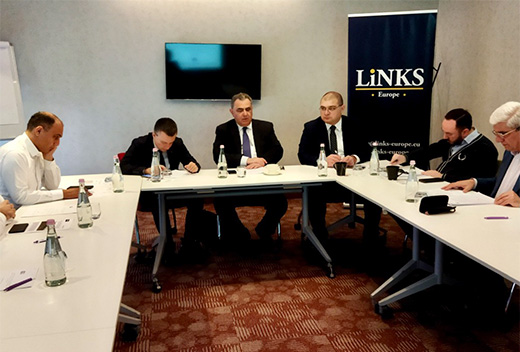 Joint Armenian-Azerbaijani Liaison Group on confidence-building measures Joint Armenian-Azerbaijani Liaison Group on confidence-building measures
The Joint Armenian-Azerbaijani Liaison Group on confidence-building measures in support of lasting peace in the South Caucasus has published its report in which it proposes 30 short, medium and long term measures in support of ongoing efforts to establish peace in the region. On Wednesday, 6 April, members of the Working Group, presented their report to the EU Special Representative for the South Caucasus, Toivo Klaar, and other EU officials at a special briefing in Brussels. In their report, published on the eve of the meeting between the leaders of Armenia and Azerbaijan and the president of the European Union in Brussels on 6 April, the group says that "all the ingredients for peace exist in the South Caucasus. All the ingredients for war exist too. What is in front of us is a choice". The group says that the proposed measures are a building block in the quest for peace but if the ideas being proposed are implemented the objective of building a peaceful, secure and prosperous South Caucasus will be much closer to being achieved. It was now necessary that all concerned should put effort into turning the thirty measures being proposed in the report into tangible action.
The work of the Joint Liaison Group was co-ordinated and facilitated by LINKS Europe - an independent foundation based in The Hague, The Netherlands - in the framework of the European Union's EU4Peace initiative. READ MORE
- September 27, 2022 08:43AM
Why is Baku Waging a “War of Words” against Tehran? By Yeghia TASHJIAN, Beirut-based regional analyst and researcher, columnist, "The Armenian Weekly”
During a meeting with Russian President Vladimir Putin and Turkish President Recep Tayyip Erdogan in Tehran on July 19, the Iranian Supreme Leader Ali Khamenei warned against blocking the Armenian-Iranian border, stating, “If there is an effort to block the border between Iran and Armenia, the Islamic Republic will oppose it because this border has been a communication route for thousands of years.” After this warning, Turkish and Azerbaijani media started paying more attention to Iranian officials and launched a “war of words.” In response to media provocations and threats toward Armenia launched by Azerbaijan, Iran facilitated the appointment of a Consulate General in Syunik to redraw its “red lines” in the South Caucasus. READ MORE
- September 27, 2022 08:32AM
Role of Shanghai Cooperation Organisation Goes beyond Managing Russia-China Relations in Central Asia By Benyamin POGHOSYAN, PhD, Chairman, Center for Political and Economic Strategic Studies
As the world comes closer to multi-polarity, the role of such organizations as SCO will grow further. Russia and China will seek to use them as a counterbalance to western dominated international political and economic organizations, such as G7, the EU, the World Bank and IMF. In the present context of emerging great power competition, the SCO started to be viewed less as a tool to manage Russia – China relations in Central Asia, or counter terrorist threats from Afghanistan, and more as a significant grouping of non-western powers in the emerging multipolar world.
The war in Ukraine has given a new impetus to the discussions about the transformation of the global order. Experts, academicians, and politicians have been debating the potential counter-weights of the emerging post-cold war order since the global financial crisis of 2008. There were different opinions about what the new world order could be like. Among the options discussed were a new bipolar world dominated by the US-China rivalry, a multipolar world where key players – the US, China, Russia, India, EU, and perhaps others – will be in a constant fight for influence and prestige, or complete chaos with no rules and no dominant players, opening the prospect of returning humankind back to a geopolitical jungle. READ MORE
- September 20, 2022 06:40AM
Israeli-Turkish Relations: Challenges and Opportunities 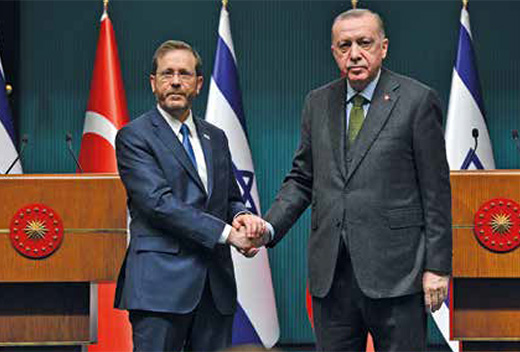 By Eugene KOGAN, Tbilisi-based defence and security expert By Eugene KOGAN, Tbilisi-based defence and security expert
Even though Israel and Turkey normalised relations in June 2016 following the May 2010 Mavi Marmara Flotilla incident when Israeli soldiers killed ten people on board a Turkish vessel and the subsequent diplomatic rupture, Ankara’s support of the Hamas movement situated in the Gaza Strip continues to undermine bilateral relations.
The establishment of an official office in Istanbul in 2012 and its members are perceived as a thorn in the eye by the Israeli Government. Tel Aviv would like Erdoğan to close the Hamas office and expel its members from Turkey; however, this Israeli wish is not going to be granted any time soon since Erdoğan’s words do not translate into deeds. The signature of the Abraham Accords highlighted two divergent trends in the region: Turkey’s continued isolation and Israel’s strengthened position. This resulted in Erdoğan’s intention to improve relations with Israel. READ MORE.
- September 9, 2022 06:38AM
Russia and Iran in Syria: A Competitive Partnership? By Igor MATVEEV, PhD, Senior Research Fellow at the Institute of Oriental Studies, and RIAC expert, Moscow
Yeghia TASHJIAN, Beirut-based regional analyst and researcher, columnist, "The Armenian Weekly”
Russia’s ongoing special military operation in Ukraine has sparked broad and intensive debates about future modalities of the relations between Russia and Iran in Syria. Western and Israeli analysts predict an essential growth of the political, military, and economic presence of Tehran due to Moscow’s attention switching from Syria to Ukraine. This, in turn, may shift the whole dynamics of the Russian-Iranian relations on the Syrian dossier. On the contrary, despite reports of minor pull-outs from Syria along with international media leaks about transfers of military sites to Iran and Hezbollah, Russian representatives consistently reject such forecasts, referring to a “routine rotation” but “absolutely not a withdrawal” of the Russian troops. Those speculations have intensified on the eve of the trilateral meeting of the Iranian, Russian, and Turkish leaders on Syria scheduled for July 19, 2022, in the Iranian capital. READ MORE
Realism Should Be the Basis for the Armenia-Turkey Normalisation By Benyamin POGHOSYAN, PhD, Chairman, Center for Political and Economic Strategic Studies
There should be realistic expectations of what can result from ongoing discussions on the normalisation of relations between Armenia and Turkey. Given the current situation in the South Caucasus, the region is far away from peace, and no one should have hopes that Armenia – Turkey normalization will solve conflicts and bring an era of peace to the region. However, in the current situation, even a contribution to regional stability is too significant an opportunity to miss.
The 2020 Karabakh war has significantly changed the geopolitics of the South Caucasus and triggered new processes. Turkey’s war involvement seemed to worsen further Armenia – Turkey relations. The Armenian government imposed a ban on imports from Turkey from January 2021 due to Turkey's open and evident promotion and support for the Azerbaijani war effort. However, after the early parliamentary elections in Armenia held in June 2021, Armenian officials started to speak about the necessity to normalize relations with Turkey. These discussions ended with the assignment of a special representatives to start negotiations, and the first meeting took place on January 14, 2022. READ MORE
The War in Ukraine and the Future of the World Order By Benyamin POGHOSYAN, PhD, Chairman, Center for Political and Economic Strategic Studies
Since the start of the Ukraine war in February 2022, discussions have been underway about the impact of the war on the evolving global order. The transformation of the world order is a very complicated and multi-layered process, and history tells us that it takes decades and is often accompanied by bloody conflicts between great powers. In the last decade, there were several prevailing predictions of the world order – a new bipolar world dominated by the US and China, a multipolar world with several equal players such as the US, China, Russia, India and the EU, and a nonpolar world characterized by constant conflicts and instability. READ MORE
Restoring Communication Links is an Important Confidence-building Measure By Benyamin POGHOSYAN, PhD, Chairman, Center for Political and Economic Strategic Studies
There is broad consensus in the region and in the international community on the need to restore communications in the South Caucasus and on the possibility of finding mutually accepted solutions for this to be achieved. However the constant focus on the routes passing via the Syunik region and connecting Azerbaijan with Nakhijevan has made the whole process of restoration of communications a bone of contention for both sides. The restoration of communications may still play a positive role in the establishment of good neighbourly relations between Armenia and Azerbaijan, by creating conditions from which both societies can benefit. However, if the sides continue this tit-for-tat discussion around the "Zangezur corridor," blaming each other for violating previous agreements, the restoration of communications issue will only deepen the mistrust between them, he adds. Starting instead with a railway connection between Armenia and Nakhijevan via Yersakh on the other hand, requires only a further 1 km of railroad to be constructed, and will serve as a significant confidence-building measure between Armenia and Azerbaijan and will make it easier for Armenia and Azerbaijan to agree on the modalities for the restoration of other routes. READ MORE
Iran and Turkey Rift Grows Over Dam Construction Projects
By Fuad SHAHBAZOV, Baku-based independent regional security and defence analyst
Tensions between Turkey and Iran were recently rekindled by the latter constructing a dam over transboundary waterways, namely the Aras, Tigris, and Euphrates rivers. Iran is accusing Turkey of intentionally triggering a regional drought and water shortage –– both of which have impacted Iran brutally. Ankara says Iran’s claims are a diversion.
A new round of disagreements between Iran and Turkey began when Iranian Foreign Minister Hossein Amir-Abdollahian criticized Turkey’s dam projects on the Aras and Tigris rivers –– the main transboundary waterways in the region –– citing the threats to water flow in the area and environmental damage to regional states in his speech before Iran’s Parliament on May 10. Abdollahian said he has called on “his Turkish counterpart at least three times over the past months to pay serious attention to the construction of dams on the Aras River.” READ MORE
|
|




 In Progress
