Publications
Eurasia After the Rise of China: The Role of Armenia  By Armine Arzumanyan, Student, Renmin University, PR of China
Aiming to create a future where all roads lead to Beijing, China now plans to obtain a global role in politics by putting itself at the centre of global economic affairs through the Belt and Road Initiative (BRI), which is the most ambitious geo-economic vision in recent history. The BRI and its goals, that have been given many different evaluations, has suggested cooperation in Central Asia, West Asia and Eastern Europe. To maintain a balanced security environment at the conjunction of Europe and Asia and to ensure a successful realization of the BRI, China will need a reliable strategic partner in the South Caucasus. This essay points out why Armenia is most likely to be the strategic ally China will need, drawing out the main perspectives and paradigms for more advanced Sino-Armenian relations. READ MORE
Publications
A Paradigm Based upon the Madrid Principles Is Not Acceptable for either Armenia or Karabakh  By Benyamin Poghosyan, PhD, Executive Director, Political Science Association of Armenia
Since the victory of the "Velvet Revolution" in Armenia, the key foreign policy issue facing the new Armenian authorities is the Karabakh conflict. The negotiation process has been stalled since the failed Kazan summit in June 2011, and the April 2016 four day war made any possible movement forward even less likely. The negotiations after April 2016 were focused on the launch of confidence building measures including the establishment of the ceasefire violations investigation mechanisms and the increase of the OSCE monitoring mission personnel. However, even these modest goals were difficult to achieve as Azerbaijan was urging for a start of "substantial" negotiations on issues of territories and status, otherwise perceiving the confidence building measures as a way to cement the current status quo. READ MORE
Publications
Kazakhstan’s Successful Two-Years Membership in the United Nations Security Council 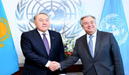 By the European Geopolitical Forum Editorial Staff
In 2018, the Republic of Kazakhstan successfully completed its two-year membership of the United Nations Security Council (UNSC). Over this period, Astana acted as an honest broker, known for its effective balanced approach and neutrality against all international actors.
In just two years, representatives of Kazakhstan took part in more than 1,000 open and closed UNSC meetings, 38 informal events, and contributed to 115 resolutions and 48 statements of the Council Presidency. READ MORE. See the original on-line media publication here
Publications
Non-alignment Policy as a Principle of Shaping the National Security of Azerbaijan  By professor Sadi Sadiyev Saleh, War College of the Armed Forces, Republic of Azerbaijan
The emergence of a bipolar world and the formation of two military blocks (NATO and the Warsaw Pact) after the Second World War ushered in an intense rivalry between different countries. Finding an effective grand strategy to survive between two hostile powers inevitably requires a balanced policy. In this context, the underdeveloped countries felt the need to join efforts for the common defence of their interests, to strengthen their independence and sovereignty and to express a strong commitment for peace by declaring themselves as “non-aligned” from either of the two nascent military blocks. READ MORE
Publications
Belarus and Azerbaijan Enhance Their Strategic Military Partnership
 By Fuad Shahbazov, Baku-based independent regional security and defence analyst
On November 19, Azerbaijani President Ilham Aliyev paid a long-awaited official visit to Belarus, where he met with his counterpart, President Alyaksandr Lukashenka. On this occasion, the Belarusian and Azerbaijani state news agencies praised the level of bilateral strategic cooperation, widely citing Lukashenka’s words to Aliyev: “Belarus has been waiting for you” (Belta, November 19). The Azerbaijani president’s trip to Minsk coincided with “growing frictions” between Belarus and Armenia, two formal allies within the Russia-led Collective Security Treaty Organization (CSTO). READ MORE
Publications
Ceasefire Violations Down as Armenia and Azerbaijan Implement South Caucasus Study Group Recommendation By EGF Editorial Staff
Since the end of October 2018, a new operative communication line (crisis hotline) has been established between Armenia and Azerbaijan, two countries that have been at war over the status of Nagorno-Karabakh (NK), a region recognized as Azerbaijani by the International Community, but inhabited by a majority Armenian population.
According to official sources from both sides, the level of military tension on the Line of Contact (LoC) between the conflicting parties has significantly decreased (from about 90 reports of ceasefire breaches/day, to about 20 reports/day). The opening of this new communication channel had been agreed several weeks before by the president of Azerbaijan, Ilham Aliyev, and the Prime-Minister of Armenia, Nikol Pashinyan, during an informal meeting held in the margins of the CIS summit in Dushanbe (Tajikistan) on 27-28 September 2018. READ MORE
Publications
Could Vladimir Putin’s Visit to Azerbaijan Shift the Regional Balance of Power?
By Fuad Shahbazov, Baku-based independent regional security and defence analyst
Russian President Vladimir Putin paid a surprise official visit to Azerbaijan, on September 27. The formal reason for his arrival was to hold talks with Azerbaijani President Ilham Aliyev as well as to jointly attend the Ninth Interregional Russia-Azerbaijan Forum. Local mass media in both Azerbaijan and Russia described Putin’s visit as a next significant step in improving the strategic partnership between the two countries. READ MORE




 By Eduard Abrahamyan, Wider Black Sea & Central Asia regional security analyst