Energy needs to give Bulgaria regional advantage  Valentin Stoyanov
EGF Affiliated Expert
Bulgaria fails to bring in the ‘big energy projects’
Over the past two decades Bulgaria has had no success with the so called ‘big energy projects’. The recent failure of NABUCCO was also a failure of the country’s efforts to diversify its gas supplies. The prospects for shale gas exploration and production look similarly grim after a moratorium was imposed by the Parliament in the beginning of 2012. READ MORE
- Friday, 17 January 2014, 07:59
Energy Relations between Gas-Troika Members and the European Union
 Fatemeh Shayan, University of Eshfahan, Iran Fatemeh Shayan, University of Eshfahan, Iran
University of Tampere, Finland
Guest contributor to EGF
Do such organisations exist beyond the ‘self fulfilling prophecy’ level?
Much research has examined energy relations between the European Union (EU) and Russia,[1] but not the larger picture of energy relations between the EU and the Gas-Troika, made up of members Russia, Iran and Qatar. Although the Gas-Troika is in an early stage of development, increasing demand for gas, especially from the EU, has noticed members to attempt to present it as a future gas superpower. READ MORE
- Friday, 17 January 2014, 07:57
A Russian-American-Syrian Triangle: The Syrian Chemical Weapons and American-Russian Relations  By Professor Andrei Kreutz,
EGF Adviser on Trans-Atlantic Security
During the last few weeks, the Syrian-American-Russian triangle directly or indirectly involving all Syria’s neighbors and a number of other nations, has become one of the major focuses of the political commentaries. The Russian initiative to help disarm Syria from its chemical weapons and Putin’s article which was published in the New York Times on September 11, 2013 apparently contributed decisively to prevent a new American military intervention in the Middle East, and brought Russia and its leader world-wide public attention, unknown since the collapse of the Soviet Union. According to the well-known American political analyst George Friedman, for the first time since the early 1990s, the Russian Foreign Minister Lavrov was able to sit with US State Secretary Kerry as an equal.
READ MORE
- Friday, 17 January 2014, 07:55
Armenia's choice of the Eurasian Union: A stunning end to its European integration?  George Vlad Niculescu,
Head of Research, The European Geopolitical Forum
The announcement at the beginning of September 2013, in Moscow, by President Serzh Sargsyan of Armenia's decision to join the Russia-led Eurasian Customs Union (ECU) apparently took many by surprise. Firstly, because in July 2013 Armenia concluded a lengthy four years negotiation on essential agreements, meant to upgrade its ties with the European Union (EU), which would be incompatible with joining the ECU. Secondly, because until recently (i.e. the run-up to the Vilnius Eastern Partnership summit to be held this fall) enlargement didn't seem a top priority for the ECU, the focus being more on making the customs union mechanisms effectively work for the existing membership. READ MORE
- Friday, 27 September 2013, 10:54
Russian Problem: Russia's Place in the World - an Attempt at Historical and Geopolitical Analysis
by Prof. Andrej Kreutz,
EGF adviser for Trans-Atlantic security
A Long Western Debate and its Political Consequences
Although Russia has been part of the European system since the Westphalian Treaty of 1648, and after its victory in the Northern War with Sweden and the Nystad Treaty in 1721 started to be seen as of he major powers on the continent, both its internal nature and its role in international politics have often suffered Western doubts and uncertainties. READ MORE
- Thursday, 19 September 2013, 12:42
Guest contribution: Gazprom is still relevant to the EU market, but for how long?
 by Professor Natasha Udensiva by Professor Natasha Udensiva
The U.S. shale gas revolution is spreading: more and more countries are talking about developing their own shale gas resources. How is this relevant for Gazprom? It is relevant because, with more countries developing their natural gas resources, Gazprom’s once-powerful monopoly may soon lose its hold on the European market. So far, the company’s strategy has relied on the exclusiveness of its vast resources. But shale development is undermining this very quickly. Soon, access to technology will trump resource access. Then, Gazprom’s only chance of reasserting its presence will be to lower its prices. READ MORE
Russia’s Soft Power: Does Moscow have any chance to achieve it?
by Prof. Andrej Kreutz,
EGF adviser for Trans-Atlantic security
The issue of soft power and its use in international relations, the concept of attracting and coopting rather than use of direct or indirect coercion as a means of persuasion, was introduced to present use by American scholar Joseph S Nye Jr. in 2002. However, both its concept and its practical use were in fact not new. Both modern and past history provides numerous examples of its previous applications. READ MORE
- Friday, 21 June 2013, 15:49
|
|


 In Progress

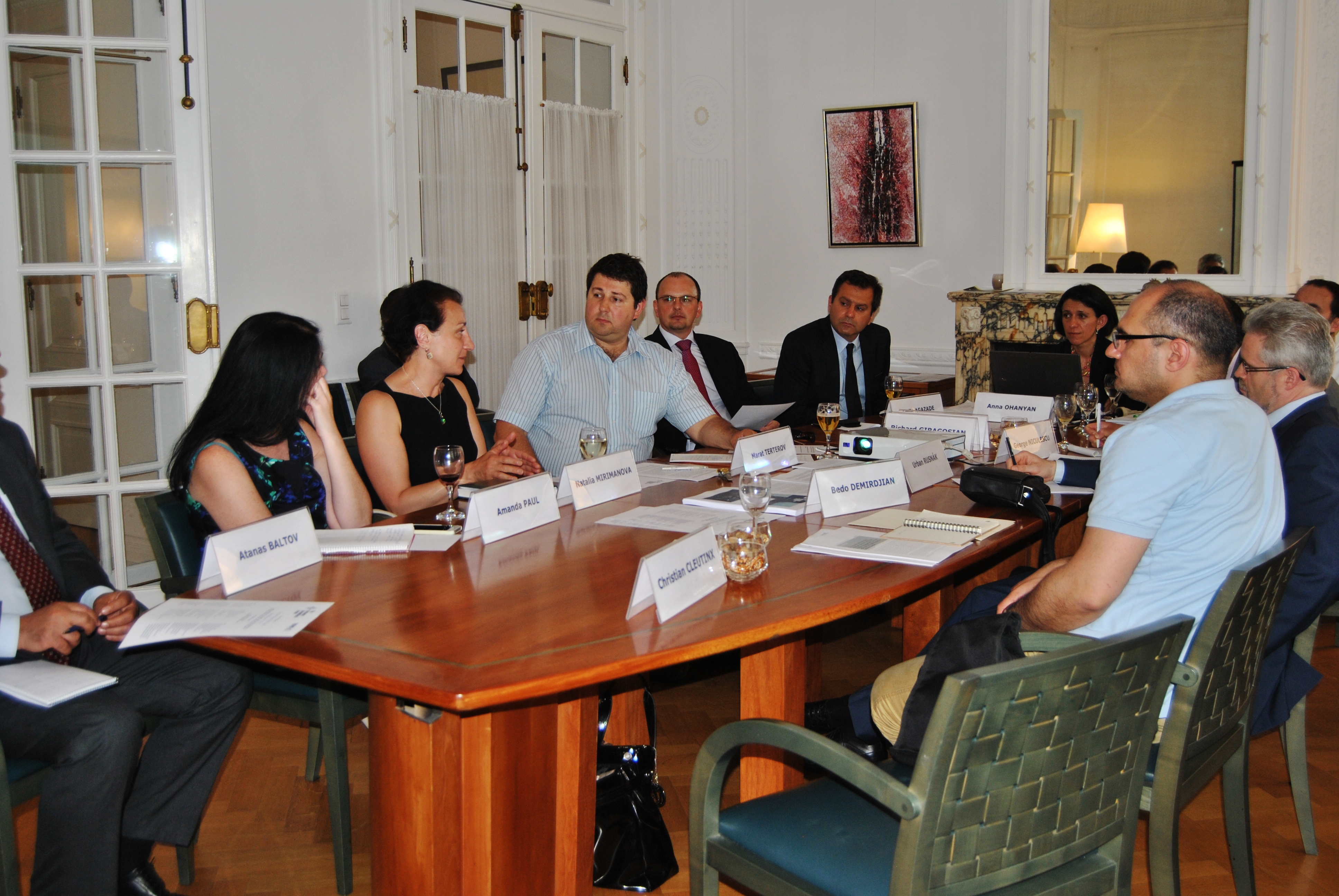 Interactive discussion hosted by the European Geopolitical Forum