Russian Problem: Russia's Place in the World - an Attempt at Historical and Geopolitical Analysis  by Prof. Andrej Kreutz,
EGF adviser for Trans-Atlantic security
A Long Western Debate and its Political Consequences
Although Russia has been part of the European system since the Westphalian Treaty of 1648, and after its victory in the Northern War with Sweden and the Nystad Treaty in 1721 started to be seen as of he major powers on the continent, both its internal nature and its role in international politics have often suffered Western doubts and uncertainties. READ MORE
- September 19, 2013 12:42PM
Political Advisory Briefing: Egypt 
By Claudia Nocente,
Research Associate Global Security
February 2013
Key points:
- Egypt’s new administration between international praise and domestic unrest
- Morsi assumes pharaonic powers in an attempt to rid Egypt of Mubarak judges
- The felool take another shot in Egyptian politics
- The generals remain silent
- The Egyptian economy sinks. READ MORE
- February 12, 2013 14:21PM
A Pragmatic Review of Nagorno-Karabakh Conflict Resolution: Could Economic Incentives Help Break The Current Stalemate? In this research, we attempt to take a more pragmatic approach towards the topic of the conflict resolution process between Armenia and Azerbaijan over Nagorno-Karabakh. We believe this process remains in a dangerous state of stalemate at the time of writing. More specifically, we ask whether economic incentives could help break the current deadlock. In order to do this, we posed a series of questions to a notable range of international experts familiar with the conflict, asking as to whether an approach towards conflict resolution where Armenia would return some land to Azerbaijan in return for the latter providing access to regional energy and infrastructure projects could contribute towards breaking the stalemate. The “return of land”, in the context of our research, refers primarily to the seven districts of Azerbaijan which Armenian forces took during the Karabakh war of the 1990s and which remains under Armenian control to this day. We do not assume the “return of land” to mean the return of the Nagorno-Karabakh enclave itself. At the outset of our research, we were optimistic that the “economic incentives” approach could offer a fresh dimension to conflict resolution in relation to the current stalemate over Nagorno-Karabakh. We felt that all parties could exercise a degree of “Caucasus pragmatism” if the right arguments were appropriately presented to governments and public, bearing in mind the widespread desire to see the region “take off” economically. Click here to read more.
China and the Iranian Nuclear Crisis: Between Ambiguities and Interests  Djallil Lounnas, Djallil Lounnas,
EGF Affiliated Expert with focus on Insurgency and Trans-national radicalism in North Africa and Sahel-Sahara
This article analyses, the complex relationship between Tehran, Beijing and Washington on the Iranian nuclear issue. Indeed, China’ policy towards Iran has often been described an ambiguous, in supporting Washington, on the one hand, while protecting Tehran, on the other hand. In this article, we argue that, in fact, Beijing policy vis-a-vis Tehran depends on the state of its relationships with Washington. Indeed, a closer analysis shows that China is using Iran as a bargaining chip with the United States on, among others, two key security issues, i.e., Taiwan and the oil supply. e guarantee of a secured oil supply from the Middle-East in addition to a comprehensive policy of the US with regard to Chinese security interests in Taiwan as well as the use of smart sanctions against Tehran, which would thus take into account, to a certain extent, Beijing economic interests in Iran, are, indeed, the guarantee of Beijing’ support to the US policy towards Iran. Click here to read more.
North Africa after the Arab Spring Political Outlook for Morocco, Algeria, Tunisia, Libya and Egypt
Key points:
- Morocco’s monarchy seems to have survived the wind of change blowing on Arab countries last year and is
currently trying to hold on to its power by allowing reforms that partly reduce its absolute authority.
- The adoption of a new constitution and the victory of moderate and nationalist Islamic parties are signs that
mark Morocco’s gradual progress towards the demands of protesters who have taken the streets last year.
- However, civil society is not yet a primary actor in Moroccan politics and a widespread sense of communalism
is still missing.
- Tensions are still present in Morocco, due to the unresponsiveness of the central government regarding the
high levels of unemployment, structural corruption and deficiencies in welfare and health systems.
- Morocco has been praised by the international community for its counter-terrorism efforts, although major
security risks stem from the unresolved situation of West Sahara. High unemployment and persisting poverty,
however, continue to ensure fertile grounds for terrorist recruiters.
- New economic deals with the EU are expected to have a positive impact on the Moroccan economy, which is
of great interest for foreign direct investors.
READ MORE
Kofi Annan’s Syrian mission  Mikhail Roshchin Mikhail Roshchin
Former United Nations Secretary General Kofi Annan appears to have made some diplomatic strides in efforts to mediate the violent uprising in Syria. And Annan’s mission also has gained Russian support, which is a crucial key to an international consensus on how best to resolve the Syrian conflict. We are joined on the line with Mikhail Roshchin, a Senior Research Fellow at the Institute of Oriental Studies at the Russian Academy of Sciences. READ MORE
Letter from Istanbul, by EGF International Expert on Energy Security, Mehmet Oguctu  by Mehmet Öğütçü by Mehmet Öğütçü
In his “Letter from Istanbul”, EGF International Expert on Energy Security, Mehmet Oguctu, argues that for the first time in several generations, there is a credible belief within Turkey that with the right policies, institutions and leadership, the country could well sit on the management board of the new world order by 2023, the centenary year of the founding of the modern Turkish state. Click here to read Mehmet Ogutcu’s letter
Turkey’s European Path: A Fact Finding Tool Box  By Deniz Altinbas, By Deniz Altinbas,
Assistant Professor, Ahi Evran University, Turkey,
EGF Affiliated Expert
A History of Turkey’s European Aspirations in Brief
Contrary to conventional opinion, Turkey’s interest in being part of the Western world did not start with its application to the European Economic Community (EEC). In fact, Turkey’s European orientation, diminishing as it is at present, began with the Rescript of Gulhane of 1839 (Tanzimat Fermani) and the Reform Edict of 1856 (Islahat Fermani). Among many other reasons, the major aim of the 19th century effort was the building of a Western model of state and society in wake of the declining power of the Ottoman Empire. READ MORE
Armenia's choice in Nagorno-Karabakh: peaceful resolution or another war with Azerbaijan? 
By George Niculescu,
EGF Affiliated Expert
In the aftermath of the failed summit hosted by the Russian president Dmitry Medvedev between his Azerbaijani and Armenian counterparts, held in Kazan (Russia) on 24 June 2011, with a view to agreeing on a peaceful settlement of the "frozen conflict" in Nagorno-Karabakh, it seems that the future of South Caucasus might be threatened by the specter of a new war. Although the agreement expected from the Kazan summit was politically backed by a previous US-French-Russian summit in Deauville (France) on 26 May 2011, the two conflicting parties have eventually turned it down, placing under a big question mark the whole notion of pursuing international negotiations on Karabakh. Reportedly, a senior official in the Kremlin, reflecting president's Medvedev's frustration with the outcome of the Kazan summit, had declared: "Unless Armenia and Azerbaijan display a readiness soon to solve the accumulated problems, we will consider this mediating mission over" (Kommersant, 27 June 2011).
Ukraine fails again to receive gas discount from Russia 
ISSUE #21
06/13/2011
On 7 June 2011, Ukrainian Prime Minister Mykola Azarov visited Moscow.
During his visit, the Ukrainian prime minister and his Russian counterpart,
Vladimir Putin, participated in a meeting of the Committee on Economic
Cooperation of the Ukrainian-Russian Interstate Commission. READ MORE
EGF Turkey File A snapshot of Turkey’s domestic and regional politics during April 2011
Key Points:
- Turkish leaders continue to navigate the ongoing “Arab Spring”, this time as it moves to Turkish borders with protests engulfing Syria.
- Turkey’s record with press freedom remains under scrutiny, as the NGO, Journalists Without Borders, condemns the country in the run-up to the June 12 elections.
- The political situation in Turkey’s southeast remains volatile, with the Turkish military breaking up large scale protests by Kurdish demonstrators in the city of Hakkari on April 25
- Suggestions by finance experts allude to the overheating of the Turkish economy, while the Turkish Central Bank’s new head moves to quell such speculation.
- The Turkish Prime Minister announces plans for an Istanbul canal that some experts say could replace the need for the country’s participation in the EU-driven NABUCCO gas pipeline project. READ MORE
Victory Day festivities in Lviv turn into clashes between nationalist groups, representatives of left- wing, pro-Russian organizations, veterans, police
ISSUE #17
05/16/2011
The celebration of the victory in the 1941-45 Great Patriotic War in Lviv turned into disturbances and clashes. On 9 May 2011, in Lviv representatives of nationalist groups clashed with
individuals who were celebrating Victory Day – members of the Communist Party of Ukraine (CPU), the pro-Russian Motherland and Russian Unity parties and veterans. In particular, members of nationalist parties attempted to prevent veterans and civilians from laying flowers at the tomb of soldiers who died in the war. For their part, the supporters of the Motherland and Russian Unity parties unfolded a 30-meter Soviet red flag, which they handed over to local veterans. Nearly 20 people were injured as a result of the clashes. A member of the Freedom nationwide organization was even shot in the leg. READ MORE
Ukrainian business ready for work at Russian market – Experts 
The Gorhenin Institute held a round table discussion - Prospects for Ukrainian Business in Russia - on 8 February. Experts and businessmen discussed the most promising areas of cooperation for Russian and Ukrainian business.
President of UPEC Industrial Group Anatoliy Girshfeld considers that Ukrainian business has prospects in Russia in the knowledge-based industry sector while operations in raw material sectors may hampered with strong government regulation. ‘The government actively regulates the raw materials and associated industry sectors and it won’t loose it’s hands on it. This is the main source of the budget income’, - O.Girshfeld said. ‘The state of the knowledge-based industry is a common problem to the entire post-Soviet space. That is why Russia has to allow entering its markets the companies developing in the knowledge-based industry, even in strategic sectors,’ – A.Girshfeld said. READ MORE
- February 17, 2011 09:50AM
Viktor Yanukovych: Ukrainian Corrupt Officials are hiring foreign lobbyists
ISSUE #04
02/15/2011
The President of Ukraine does not agree with the statements that the fight against corruption in Ukraine only targets the people that are in opposition to the current Government.
The Head of State says the corrupt individuals, trying to avoid responsibility, are using various lobbying groups in the country as well as overseas with the purpose of discrediting the actions of the Ukrainian authorities. The President reminded that everybody should be held responsible for corrupt acts regardless of what political party they belong to. READ MORE
- February 17, 2011 09:45AM
Ukrainians are not afraid of terrorist attacks – survey
On January 24th through January 26th, 2011, Gorshenin Institute has conducted a phone survey "Explosions in Makeyevka". A total of 1000 respondents age 18 or older representing all 25 regional centers, Kiev and Sebastopol, were selected at random following a systematic procedure aimed at filling sex, age and community quotas. The margin of error is no higher then +/-3.2%. Results of the survey conducted among the residents of Makeyevka are presented separately. READ MORE
EGF Turkey File December 2010
Key positions:
• In recent months Turkey has witnessed harsh prison sentences and threats of litigation by Turkish authorities in response to Kurdish protests and unfavourable press respectively in the past months. This is a worrying sign in that after nearly a decade in power, AKP authorities have become just as reactionary as the military backed governments of previous decades, only this time with an Islamic tinge.
• At the NATO Lisbon Summit on November 19-20, Ankara claimed victory for swaying its allies away from designating Iran as the main threat facing the alliance with regards to a proposed missile defence system which NATO is currently considering. While Turkish government officials indicated prior to the conference that they would demand command and control of the system if based on their territory, in Lisbon, that decision was put off for future discussion.
• Wikileaks’ release of American diplomatic cables have detailed the gossip and personalities of leading AKP politicians, but offered little else that could be described as damaging.
• In regional energy developments, Russia and its energy subsidiary, Gazprom, have been opting for pragmatism over threats in recent months by signing deals throughout the region with Bulgaria, Serbia, and Ukraine in order to strengthen prospects of realising the South Stream gas pipeline. Brussels and Sofia, for their part, have reached an agreement on bank guarantees for Nabucco (the EU’s rival to South Stream). READ MORE
- December 20, 2010 20:29PM
The IMF is satisfied with Ukraine yet is bringing forward more demands to continue the cooperation
ISSUE #19
11/19/2010
Head of the International Monetary Fund (IMF) mission in Ukraine Thanos Arvanitis said that Ukraine had fulfilled all main obligations within the framework of the cooperation program with the IMF. Prime-Minister of Ukraine Nikolay Azarov predicts that by the end of 2010 the Board of Directors of the IMF would decide on granting Ukraine the second tranche of the loan in the amount of 1.6 billion dollars. READ MORE
- December 15, 2010 09:09AM
EGF Turkey File
November 2010
Key positions:
• David Cameron’s forceful remarks over the summer on Turkey’s stagnant accession talks have hit a nerve in some circles in Brussels. Criticism of fellow German and French members of the EU by the prime minister on bias and playing to xenophobic political moods has addressed the elephant in the room over Turkey’s much debated membership application. Brussels is predicted to endorse the recent referendum results from Turkey as a positive step in its long standing bid to join the EU.
• A Turkish court struck down the headscarf ban in public universities recently, but no major social disturbances have been reported. The lack of social unrest over such a divisive issue seems to further demonstrate that Turkey is enshrining the values of a law based democratic society where sensitive political issues are settled in the courts and at the ballot box rather than in the streets. Meanwhile the Ergenekon trial (Turkey’s new national coup plot) has faded from national attention as the Istanbul prosecutor’s office has declined to pursue the case citing lack of verifiable evidence.
• The Turkish National Petroleum Corporation has recently won two major contracts in developing the two largest Iraqi gas fields, further increasing Turkey’s interests in its neighbour. This has not alleviated some concern in the business sector that warns a ballooning trade deficit over the past year has dire consequences for the long-term future of business growth.
READ MORE
- November 30, 2010 05:57AM
EGF Turkey File September 2010
John Van Pool
EGF Turkey Geopolitics Analyst
Key positions:
- British Prime Minster David Cameron’s recent speech to the Turkish Parliament, which gave strong support for Ankara’s EU membership bid, is likely to have caused more reaction from European national leaders had it been delivered in Brussels
- Last month’s agreement between Chevron and Turkish Petroleum to explore two deep-water wells in the Black Sea is a reflection of the Turkish government’s efforts to make the country self sufficient in oil and gas production by 2023
- Italian energy company ENI has attempted to reach a compromise for its role in the competing Nabucco and South Stream pipelines by reaching an agreement with Turkmenistan and Azerbaijan in which compressed natural gas reserves will be transported by ship across the Caspian Sea, which will provide supplies to both pipelines without alienating either project’s backers.
- Turkey’s National Security Policy Document (also known as the ‘Secret Constitution’), which is due to be reviewed shortly, will identify energy security as the country’s most pressing strategic issue, and will remove Russia, amongst other neighbours, from the countries it would consider as potential enemies. READ MORE
|
|




 In Progress

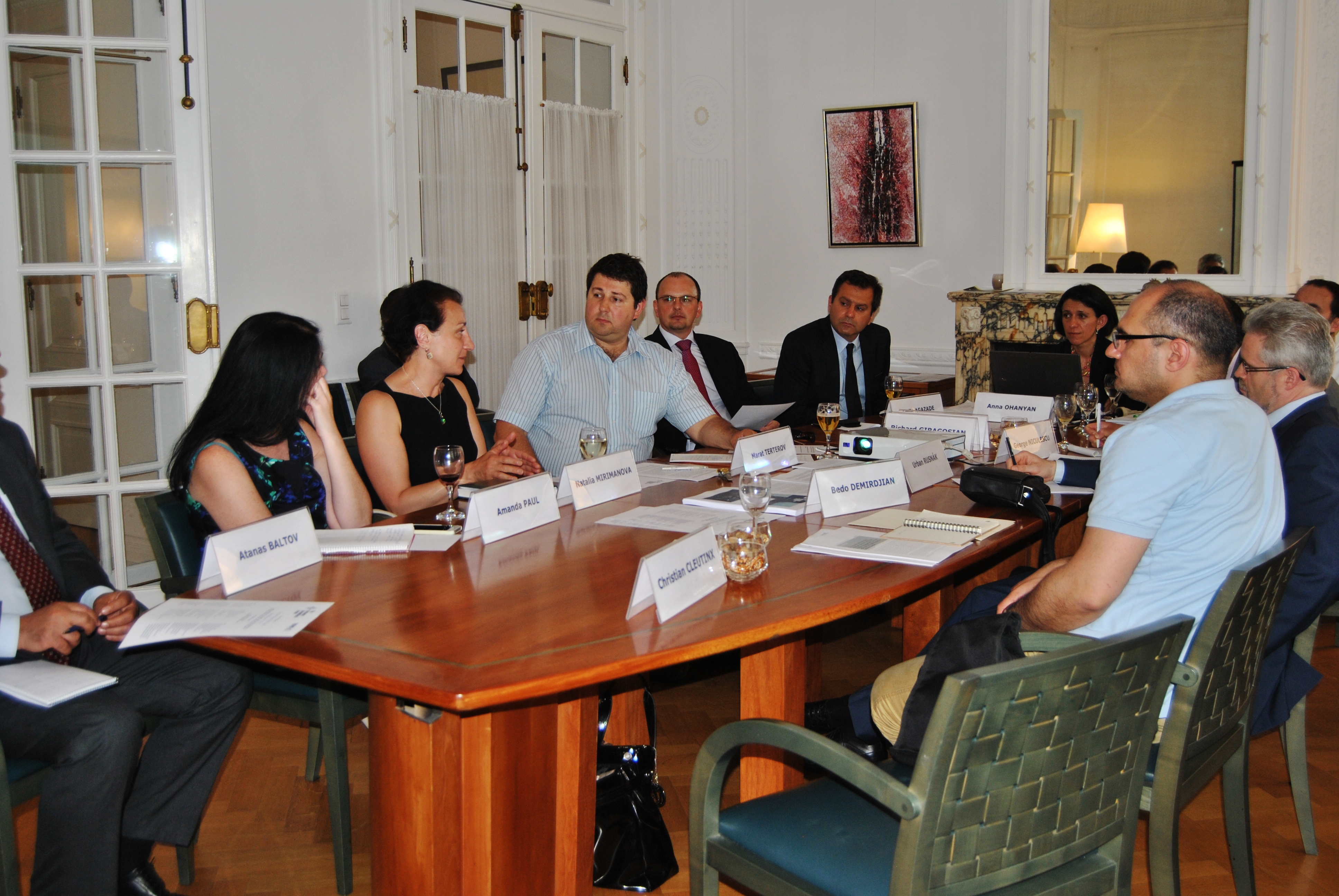 Interactive discussion hosted by the European Geopolitical Forum