The South Caucasus between Russia and the European Union
 Elkhan Nuriyev, Elkhan Nuriyev,
EGF Affiliated Expert
The mounting tension over Ukraine has introduced numerous dangers to the security situation in the South Caucasus. These negative ramifications are further exacerbated by the fact that Russia holds the key to resolving conflicts in the post-Soviet realm, especially in the absence of greater Western assertiveness. But Moscow and Brussels are caught up in geopolitical competition over the region. READ MORE
Stakeholder Consultation Round Two - Exploring the Role of Economic Initiatives as Peace Building Tools in the Nagorno-Karabakh Context [UPDATED]
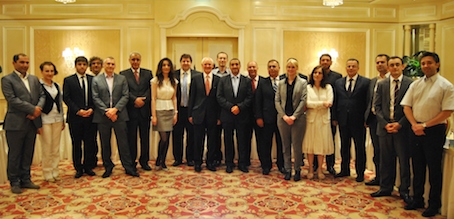
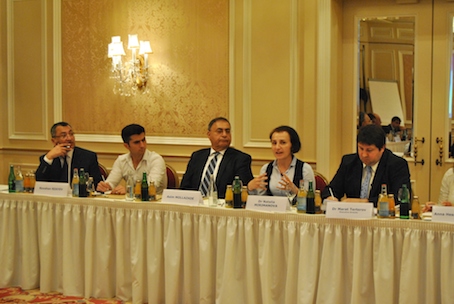
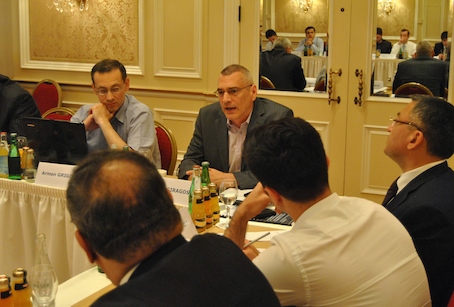
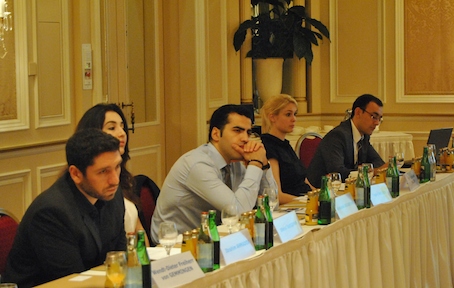
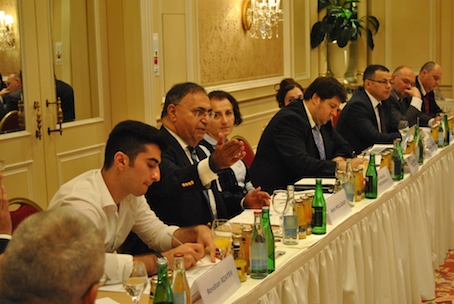
The second stakeholder consultation round in EGF's ongoing Nagorno-Karabakh research took place on 06-08 July 2014 in Berlin (Germany), including introduction of a post-conflict scenario building workshop. More than 30 experts from Armenia, Azerbaijan, and international partner NGOs and institutions attended this highly successful event, held in a constructive atmosphere of exchange. It has been the first step towards exploring the idea of a roadmap leading towards an economically integrated South Caucasus, and created a platform for exchange of information between Armenian and Azerbaijani experts. During the post-conflict scenario building workshop, regional participants simulated the negotiation of a roadmap for the implementation of economic components of a peace agreement built upon the Madrid principles, encompassing joint economic measures in areas such as energy, transport, trade, rehabilitation of the territories affected by the conflict, and the return of IDPs to their homeland.
Please click here for the summary of conclusions.
Please click here to see the agenda of the seminar, and participants’ biographies.
Please click here to see the EGF presentation on this research.
One man, one party hangs onto power in Montenegro  Vasilije Boskovic, Vasilije Boskovic,
EGF Guest Contributor
Montenegro is the only former Yugoslav republic where there was no change of government since 1989. The same political party, the Democratic Party of Socialists (DPS), has ruled for 25 years consecutively. The party is led by Prime Minister Milo Djukanovic, who was also president of the Republic of Montenegro from 1998 to 2002. What are the reasons the same political elite can hold onto power for more than two decades? READ MORE
Click here to read also "Protest virus appears contagious in Bosnia".
- Tuesday, 25 November 2014, 20:54
Implications of the Crimea Crisis for Energy Markets: Vulnerabilities of Markets and Weakness of States
 Dr Andrei V. Belyi, Dr Andrei V. Belyi,
EGF Guest Contributor
A crisis of international governance spreads into the political sphere and puts under peril the peace between the Russia and Ukraine, in addition to heightening tension between Russia and the West. The political rhetoric from Brussels, Moscow and Washington increasingly resembles that of the Cold War. Many ask if there are serious implications in security of energy supply, as well as in investment and trade, either among causes or consequences of current events. The current situation demonstrates a deep vulnerability of states in the face of markets, and will be analysed along three groups of energy implications: transit-supply flows, investments and effects of sanctions. READ MORE
- Tuesday, 25 November 2014, 20:53
Exploring the Role of Economic Initiatives as Peace Building Tools in the Nagorno-Karabakh Context
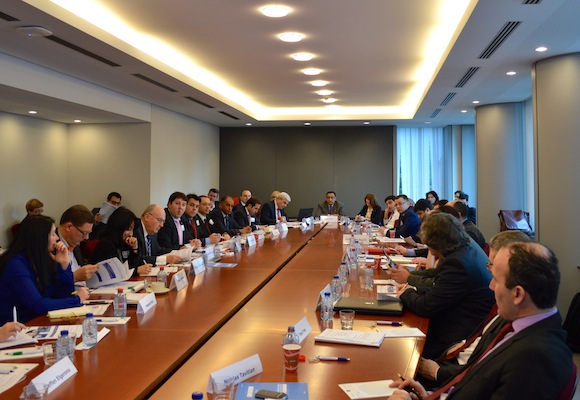
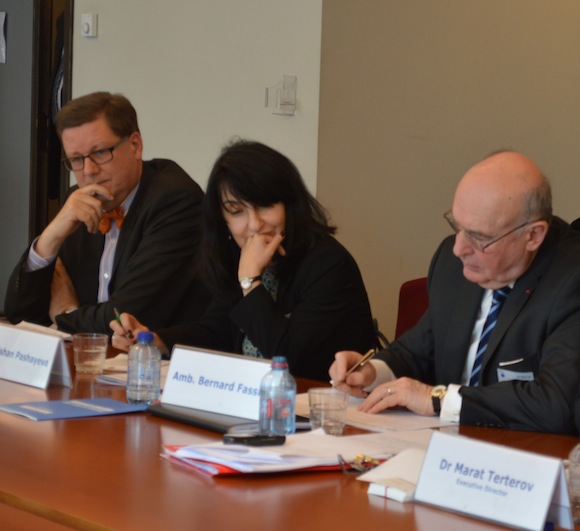
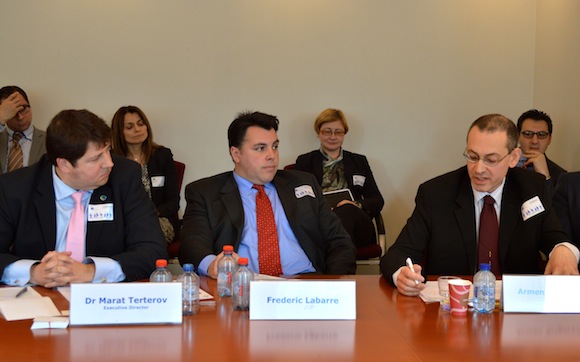
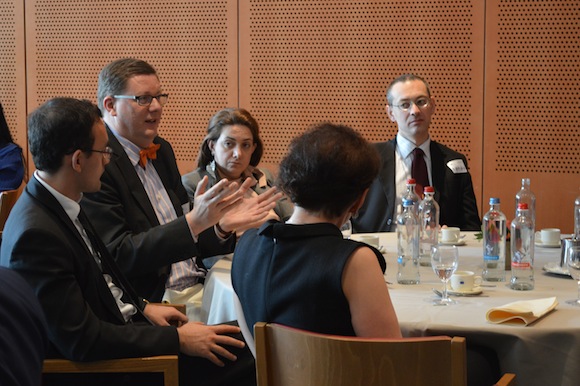
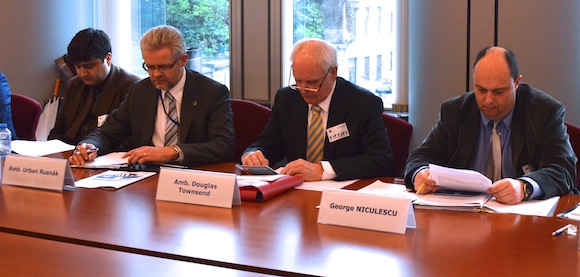
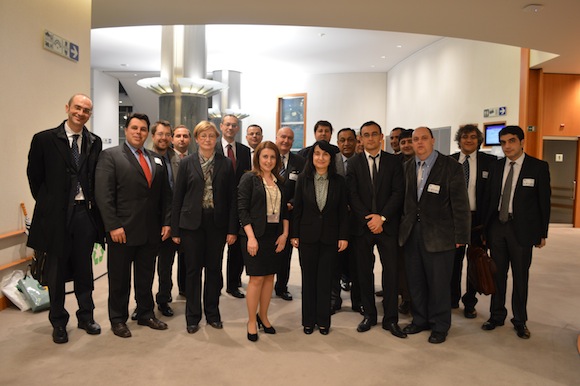
A highly successful roundtable discussion on Exploring the Role of Economic Initiatives as Peace Building Tools in the Nagorno-Karabakh Context took place on the 27th of March, 2014, at the European Parliament. The event was organized by the European Geopolitical Forum and international NGO partners, and was attended by more than 40 experts from the South Caucasus region and Brussels-based think tanks and international organizations who engaged in discussion in a constructive, informal ‘atmosphere of exchange’. The roundtable focused constructive energies on discussing a common future in an economically integrated South Caucasus, as a way to build mutual trust aimed at helping to overcome the current stalemate within the political and security negotiations. Please click here for the summary of conclusions of the event. READ MORE.
- Wednesday, 16 July 2014, 20:33
Russian Gas Supplies to Europe: the Likelihood, and Potential Impact, of an Interruption in Gas Transit via Ukraine
 Jack Sharples, EGF Associate Researcher and Andrew Judge, EGF Guest Contributor Jack Sharples, EGF Associate Researcher and Andrew Judge, EGF Guest Contributor
The current tensions in Ukraine have generated speculation about the security of Russian gas supplies to the EU via Ukraine. This short article analyses the likelihood of a suspension of Russian gas supplies via Ukraine and the impact of such a suspension on EU gas imports. We find that a suspension of gas transit is far from inevitable, but cannot be ruled out. The impact of such a suspension would disproportionately affect Central and South-East Europe, with this region divided between those that have access to gas storage and/or alternative supplies, and those that do not. In this regard, Bulgaria remains the only EU member state in this region that has neither sufficient gas storage nor access to alternative supplies. READ MORE
- Monday, 24 March 2014, 19:30
After the Vilnius Summit: EU’s Eastern Partnership at Crossroads  George Vlad Niculescu,
Head of Research, The European Geopolitical Forum
The Eastern Partnership Summit, held on 28-29 November 2013 in Vilnius, was supposed to highlight the progress achieved over the last four years by the EU on political association and economic integration with its eastern neighbours (Armenia, Azerbaijan, Belarus, Georgia, Republic of Moldova and Ukraine). Although it resulted in initialling the Association Agreements of Georgia and Moldova, and in signing a few minor agreements with other eastern partners, the summit was hijacked by the growing geopolitical competition between the EU and Russia. The primary victims of this competition have been Armenia and Ukraine, who, under strong pressure from Russia, put off their plans to sign Association and Deep and Comprehensive Free Trade Area agreements with the EU. Other eastern partners have also felt the cold wind blowing across Europe within their economic, energy or security relations with Russia. READ MORE
- Friday, 17 January 2014, 08:00
|
|





 In Progress


 Ben McPherson,