Azerbaijan Moves to Disarm Karabakh Separatists (Part Three)[Over]  By Vasif HUSEYNOV, PhD, Head of Department, AIR Center, Adjunct Lecturer, ADA and Khazar Universities, Baku By Vasif HUSEYNOV, PhD, Head of Department, AIR Center, Adjunct Lecturer, ADA and Khazar Universities, Baku
On September 28, the leader of the separatist regime in Karabakh signed an order to dissolve all “state” agencies and organizations by the end of 2023. This was accompanied by a mass exodus of the Armenian population from the region. According to Armenian sources, more than 100,000 Armenians have left Karabakh as of October 1. The Yerevan office of the United Nations High Commissioner for Refugees (UNHCR) said those fleeing Karabakh have not reported maltreatment. “Nobody has shared instances of being harassed,” said Kavita Belani, the UNHCR representative in Armenia at a recent news conference. It has also been reported that some Armenians have decided not to the leave the region.
READ MORE
Azerbaijan Moves to Disarm Karabakh Separatists (Part Two)[Over] By Vasif HUSEYNOV, PhD, Head of Department, AIR Center, Adjunct Lecturer, ADA and Khazar Universities, Baku
On September 20, Azerbaijan called for a ceasefire in the operation against armed detachments of the separatist regime in Karabakh. In a televised address to the nation, President Ilham Aliyev stated that Baku’s conditions were accepted by the separatist entity. He announced that the “representatives of the Armenian community living in Karabakh, who refused to meet our representatives several months ago, are ready to meet in the city of Yevlakh. Azerbaijan has disclosed that 192 servicemen were killed and more than 500 wounded during the 24-hour “anti-terrorist operation”. The Armenian side has reported at least 200 people killed and more than 400 wounded.
In preventing further escalation, the Armenian government chose not to militarily intervene in the clashes on September 19 and 20. Armenian Prime Minister Nikol Pashinyan characterized possible involvement as a threat to his country. He stated, “Armenia is not involved in military operations. I want to mention once again that Armenia does not have an army in Nagorno-Karabakh”.
READ MORE
What Next in Nagorno Karabakh[Over]  By Benyamin POGHOSYAN, PhD, Chairman, Center for Political and Economic Strategic Studies By Benyamin POGHOSYAN, PhD, Chairman, Center for Political and Economic Strategic Studies
On September 19, Azerbaijan launched a large-scale offensive against the self-declared Nagorno Karabakh Republic with only one goal: to finish with that republic. The Azerbaijani attack was not a surprise to anyone. At least since the beginning of 2023, Azerbaijan has stated clearly and loudly that Baku will not tolerate the status quo that emerged after the 2020 Nagorno Karabakh war and will do everything possible to destroy the Nagorno Karabakh Republic. Azerbaijan was also clear that it would reach its goal quickly. Since the beginning of September 2023, as Azerbaijan started to concentrate troops along the line of contact, it was clear the military offensive would take place very soon. Armenia knew that Russia knew that, the EU and the US knew that, and Nagorno Karabakh authorities knew that. What were the positions of the sides regarding the upcoming offensive of Azerbaijan?
READ MORE
What does ISIS’s revival mean for the South Caucasus?[Over]  By Yeghia TASHJIAN, Beirut-based regional analyst and researcher, columnist, "The Armenian Weekly” By Yeghia TASHJIAN, Beirut-based regional analyst and researcher, columnist, "The Armenian Weekly”
The socio-economic crisis was one of the causes of the disintegration of centralized governments in Syria and Iraq in 2011 and the emergence of radical militants in rural areas. These militants were motivated by anger towards the urban elite, who for decades neglected rural areas. As civil wars and political instability hit Syria and Iraq, many young rural people were recruited by these groups, who were financed by regional countries or non-state actors. In 2013, the Islamic State of Iraq and Syria (ISIS) was founded with the aim to establish an Islamic kingdom (caliphate) in the region. […] After the dissolution of ISIS in late 2019, the movement went underground, yet today it is taking advantage of the financial crisis in Syria and making a comeback.
READ MORE
- September 25, 2023 22:50PM
Armenia and Azerbaijan on the Brink of Renewed Conflict[Over] By Vasif HUSEYNOV, PhD, Head of Department, AIR Center, Adjunct Lecturer, ADA and Khazar Universities, Baku
On September 9, Armenian Prime Minister Nikol Pashinyan spoke on the phone with the leaders of France, Iran, Georgia and Germany, as well as US Secretary of State Antony Blinken. In a manner that resembled his outreach to various world leaders at the beginning of the Second Karabakh War (September 7–November 10, 2020), the Armenian premier warned against intensifying tensions in the region and stated his readiness for immediate talks with Azerbaijani President Ilham Aliyev without preconditions. Pashinyan’s words came on the heels of several setbacks that threaten to derail Armenian-Azerbaijani peace negotiations and may lead to another military conflict.
Both sides accuse each other of a military build-up along their shared border in preparation for an offensive. According to the Azerbaijani Foreign Ministry, a military threat also emanates from the continued presence of Armenian troops in Karabakh, despite Yerevan’s earlier pledge to withdraw them by September 2022.
READ MORE
- September 25, 2023 22:47PM
The Russia-Ukraine War and the Prospects of Conflict Resolution in Georgia [Over]  By Nika CHITADZE, PhD, Director of the Center for International Studies, Tbilisi By Nika CHITADZE, PhD, Director of the Center for International Studies, Tbilisi
One of the most important consequences of the Russia-Ukraine war is probably the fact that Russia is losing its geopolitical influence in the post-Soviet space, which Russia officially called the "near abroad", that is, the sphere of its geopolitical influence. In this direction, it should be noted that the role of Russia as a "mediator" and "peacemaker" in the field of various conflict resolution is weakening. An example of this is that Russia's role in mediating between Armenia and Azerbaijan is weakening, and therefore in solving the Nagorno-Karabakh problem. It is well known that in November 2020, it was Russia that presented us as the main "guarantor" for the settlement of the conflict between Armenia and Azerbaijan around Nagorno-Karabakh, when it seemed that Russia stopped hostilities in Nagorno-Karabakh and deployed its own "peacekeeping forces".
READ MORE
- September 15, 2023 07:04AM
Incidents along Armenia-Azerbaijan Border Show Urgent Need for an Incident Prevention Mechanism[Over] By Benyamin POGHOSYAN, PhD, Chairman, Center for Political and Economic Strategic Studies
As the sides are coming closer to the signature of a peace agreement, steps should be taken to solve the issues along the Armenia – Azerbaijan state border and the line of contact. The population of the self–proclaimed Nagorno Karabakh Republic and Armenians and Azerbaijanis living along the state border have the inalienable right to live in a secure environment while external actors are moving forward with their geopolitical ambitions. In this context, a concrete measure to ease tensions can be the establishment of an incident prevention and response mechanism.
The restart of intensive Armenia – Azerbaijan negotiations in May 2023 gave hope that an Armenia – Azerbaijan peace agreement is within reach. Meetings in Washington, Brussels, Moscow, and Chisinau seem to have paved the way for a deal by the end of 2023. Officials from both countries started to sound more optimistic regarding the prospects of peace and stability in the South Caucasus. The Armenian and Azerbaijani foreign ministers will have another round of talks in Washington in the next days, and the President of the European Council Michel will host Prime Minister Pashinyan and President Aliyev in Brussels on 21 July.
READ MORE
Ukraine's Counter-offensive and Possible De-occupation of the Country[Over] By Nika CHITADZE, PhD, Director of the Center for International Studies, Tbilisi
As expected, Ukraine's counteroffensive against the Russian occupation forces has already begun, although it has not yet entered the decisive phase. It should be noted that the past 5 months were particularly difficult for Ukrainian soldiers - the period when Ukraine began to save forces to prepare for a large-scale counteroffensive. In recent months, Ukraine has withdrawn most of its combat-ready units from the front line, and thousands of Ukrainian soldiers have gone abroad for training. The newly formed and refreshed brigades were left intact by the military-political leadership of Ukraine and did not involve them in heavy winter battles. All this happened against the background of the winter campaign launched by Russia - the attention of the international media was mainly directed to the battle of Bakhmut, but the Russian army was attacking in 6 other directions during the same period. Outnumbered, the Ukrainian army once again exceeded expectations and ran an overall successful defensive campaign.
READ MORE
What Would Bring to Kremlin the Deployment of Tactical Nuclear Weapons in Belarus?[Over] By Nika CHITADZE, PhD, Director of the Center for International Studies, Tbilisi
As it is known, Russian President Vladimir Putin announced that Moscow and Minsk agreed to deploy tactical nuclear weapons on the territory of Belarus. The construction of a special warehouse is already underway and will be completed by July 1 of this year. Therefore, it can be said that Putin's blackmailing strategy has entered the next acute phase, and it is theoretically possible that such steps will sooner or later push the world toward a nuclear confrontation. It should be noted that after the dissemination of information about the placement of nuclear weapons in Belarus, the US Department of Defence issued an emergency statement. It says that "the Pentagon sees no indication that Russia is preparing to use nuclear weapons." On the other hand, as Vladimir Putin told the Russian government media, ten Su-25 aircraft capable of carrying tactical nuclear weapons are already stationed on the territory of Belarus. In addition, according to him, Russia has given Belarus the "Iskander" missile system, which can also launch missiles equipped with a nuclear warhead.
READ MORE
Is Azerbaijan’s New Attack against the Artsakh Defense Army Imminent?[Over] By Benyamin POGHOSYAN, PhD, Chairman, Center for Political and Economic Strategic Studies
May 2023 will be remembered as the month of intensive negotiations between Armenia and Azerbaijan. It started from the four-day summit in Washington, where the two ministers of foreign affairs with their teams were engaged in face-to-face interactions to discuss the text of the Armenia-Azerbaijan peace agreement. Ten days later, Armenian and Azerbaijani leaders met in Brussels, revitalizing the Brussels format, which had been stalled in September 2022. As a result of the Brussels summit, the sides reiterated the mutual recognition of territorial integrity based on the Alma-Ata declaration. For the first time, they agreed to use exact numbers when describing each other’s territories. This step dispersed fears in Azerbaijan that despite signing the Prague statement in October 2022 and recognizing Azerbaijani territorial integrity based on the Alma-Ata declaration, Armenia may still avoid recognizing Artsakh (Nagorno Karabakh) as part of Azerbaijan, arguing that Artsakh was not part of Azerbaijan on December 21, 1991, when the Alma-Ata declaration was signed. A few days later, the Armenian Prime Minister confirmed that Armenia recognizes Artsakh as part of Azerbaijan during his speech at the summit of the Council of Europe.
READ MORE
Pushing Armenia to make further concessions will spoil any chance for peace[Over] By Benyamin POGHOSYAN, PhD, Chairman, Center for Political and Economic Strategic Studies
After a break of several months Armenia and Azerbaijan have now resumed their engagement in peace negotiations in earnest. After a face-to-face meeting between leaders in Munich in February, the Armenian and Azerbaijani ministers of foreign affairs went to Washington in early May 2023 to take part in the most intensive round of negotiations ever held since the Spring 2001 Key West summit between Presidents Heydar Aliyev and Robert Kocharyan. The ministers achieved progress, opening the path for the 14 May Brussels summit involving Prime Minister Pashinyan, President Aliyev, and President of the European Union Council Charles Michel. On 19 May, the Armenian and Azerbaijani foreign ministers met in Moscow, and a trilateral Aliyev - Pashinyan - Putin summit was scheduled for 25 May.
READ MORE
Azerbaijani-Iranian Tensions Disrupt the South Caucasus[Over]
 By Fuad SHAHBAZOV, Baku-based independent regional security and defence analyst By Fuad SHAHBAZOV, Baku-based independent regional security and defence analyst
On March 30, Azerbaijan officially inaugurated its first embassy in Tel Aviv, Israel, after avoiding the move for three decades. Although the decision highlighted the importance of Azerbaijani-Israeli relations, it quickly became a catalyst behind the renewed war of words between Iran and Azerbaijan. Since 2021, diplomatic relations between Tehran and Baku have steadily become embittered. Iran is primarily concerned with the decline of its influence in the South Caucasus, which has suffered since the end of the Second Karabakh War in 2020. As such, in an attempt by Tehran to flex its muscles and intimidate Azerbaijan, the Islamic Revolutionary Guard Corps conducted large-scale military drills on the border with Azerbaijan in October 2022. Unlike previous years, the exercises provoked an uneasy reaction within Azerbaijan and triggered anti-Iranian sentiments throughout the country. READ MORE
Armenia needs to better explain what it means by an international presence in Nagorno-Karabakh[Over] By Benyamin POGHOSYAN, PhD, Chairman, Center for Political and Economic Strategic Studies
As Armenia – Azerbaijan negotiations entered a more active phase after a months-long limbo with marathon discussions in Washington, an upcoming trilateral meeting at the level of foreign ministers in Moscow, and a possible Pashinyan – Aliyev summit in Chisinau on 1 June 2023, the key contested issue remains Armenia's demand for a long-term international presence in Nagorno Karabakh and the establishment of an international mechanism for Azerbaijan – Nagorno Karabakh negotiations.
In his 5 May 2023, interview with Radio Liberty, Armenian Prime Minister Pashinyan stated that the rights and security of Nagorno Karabakh Armenians remained the main issue, where the sides still had divergent views. The concept of "rights and security of Nagorno Karabakh Armenians" came into centre stage in early 2022, as the Armenian government dropped its demand for autonomy for Nagorno Karabakh within Azerbaijan. Since Spring 2022, Armenia has avoided the terms of status and self-determination in its rhetoric on Nagorno Karabakh, instead emphasizing the necessity to protect rights and provide security for Nagorno Karabakh Armenians.
READ MORE
The Armenian Government Needs to Communicate Better to the Public what EUMA Is About[Over] By Benyamin POGHOSYAN, PhD, Chairman, Center for Political and Economic Strategic Studies
Efficient strategic communication has become necessary in the South Caucasus as the governments of the region and outside regional and global powers vie for influence in the current highly complex geopolitical realities. One of the priorities for the Armenian government is to explain clearly to public opinion what the recently deployed EU Monitoring Mission is and is not about. Otherwise, the same disappointment that emerged towards Russia earlier will surely appear as regards the European Union also.
The ups and downs in the Armenia – Azerbaijan negotiations process after the end of the 2020 Nagorno Karabakh war, the launch of the Russia – Ukraine war, and the complete rupture of Russia – West relations added complexity to the geopolitical realities of the South Caucasus. Too many actors have contradicting interests in region – Russia, the US, the EU, Iran, Turkey, and Israel.
READ MORE
Is War between Iran and Azerbaijan Out of the Question?[Over]
By Fuad SHAHBAZOV, Baku-based independent regional security and defence analyst
Tensions between Azerbaijan and Iran have grown rather raw recently in the wake of Baku’s inauguration of its first-ever embassy in Israel. Of course, diplomatic relations between the neighbours have steadily become more and more inflamed and embittered for several years now, with Iran concerned at the declining influence in the South Caucasus it has suffered since the second Karabakh war between Azerbaijan, urged on by Turkey, and Armenia in late 2020. And with a normalisation of diplomatic ties between Tehran and Baku unlikely in the near future, the big question remains unanswered: Is it possible that the tensions could escalate into a large-scale regional conflict?
The war of words between the two countries was aggravated in October 2022 when Iran's Islamic Revolutionary Guard Corps (IRGC) conducted large-scale military drills on its border with Azerbaijan. Baku opted to refrain from responding to the exercises with comments that might antagonise Tehran. However, the situation became even more explosive when, in late January, an Iranian citizen armed with a rifle burst into the Azerbaijani embassy in Tehran and killed the building’s security chief and injured two of his colleagues. READ MORE
The History and Evolution of Iran’s National Drone Program[Over]
By Fuad SHAHBAZOV, Baku-based independent regional security and defence analyst
Russia’s invasion of Ukraine launched in early 2022 has fundamentally changed the international security architecture that had existed for many years, but it has also caused global political and economic cataclysms. Although Russian forces made significant gains thanks to heavy artillery fire, including missile strikes on cities all over Ukraine in the first weeks of combat, Ukrainian defenders quickly rebuffed attempts by consolidating its military power, exercising diplomatic connections, and launching counterattacks at Russian positions. The failures of continuous artillery and missile strikes in the following months prompted Russia to make some changes in its military tactics. As a result, Russia was forced to seek help from its traditional allies China and Iran through unofficial channels. Although China has refrained from overtly providing military support to Russia in order not to further complicate relations with Western countries, particularly with the United States, Iran began supplying locally produced long-range attack (suicide) drones to Russia. READ MORE
Munich Conference Casts Optimistic Light on Azerbaijani-Armenian Peace Process[Over]
By Fuad SHAHBAZOV, Baku-based independent regional security and defence analyst
On February 19, Azerbaijani President Ilham Aliyev and Armenian Prime Minister Nikol Pashinyan attended the discussion panel regarding the South Caucasus at the Munich Security Conference. Afterward, they held a face-to-face meeting on the side-lines of the conference with the mediation of United States Secretary of State Anthony Blinken. Ultimately, the parties focused on the points at the top of their respective agendas, and as a result, they failed to reach a significant agreement on many key issues, including the status of the Lachin road and future development of the Zangezur Corridor. Aliyev revealed in a later interview that he had proposed to the Armenian side the establishment of bilateral checkpoints at both ends of the Zangezur Corridor and along the Lachin road. Since the end of the Second Karabakh War in 2020, Azerbaijan has long sought the establishment of this desired corridor through Armenia’s Syunik province to connect the country with its Nakhchivan exclave, albeit unsuccessfully. Thus, debates over the Zangezur project, among other issues, have led to a stalemate in peace negotiations, with regional actors, such as Iran, strictly standing against the project and supporting Armenia in its opposition. READ MORE
Diversification of Armenian Security and Defence Policy and the Role of India[Over] By Benyamin POGHOSYAN, PhD, Chairman, Center for Political and Economic Strategic Studies
The 2020 Nagorno Karabakh war has significantly changed the balance of power in the South Caucasus, increasing the role and influence of Turkey. The direct involvement of Turkey in the war and the lack of action by Russia to prevent this NATO member state from challenging the Russian zone of influence in the post-Soviet space crushed the basics of the Armenian foreign and security policy. Since the end of the first Nagorno Karabakh war in 1994, Armenian military doctrine has been based on the core belief that Russia will not allow direct Turkish involvement in a new war against Armenia. Thus, Armenia prepared itself for the war with Azerbaijan while outsourcing to Russia the deterrence of Turkey. Meanwhile, this mindset also resulted in a Russia-focused defence and security policy. Armenia was buying weapons mainly from Russia, almost all Armenian officers were studying in Russian military universities, and the structure and operating mode of the Armenian army was solely based on the Russian model. Armenia developed limited defence cooperation with other nations, including the US, Greece, and Poland, and signed its first Individual Partnership Action Plan with NATO in 2005. However, these sporadic interactions did not change the basics of Russia-focused foreign and military policy. READ MORE
Turkey Holds the Nordic Countries at Gunpoint: Implications for NATO[Over] 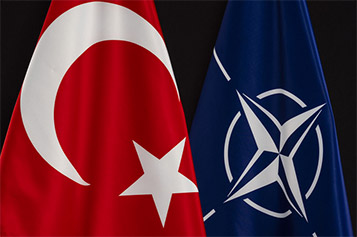 By Eugene KOGAN, Tbilisi-based defence and security expert By Eugene KOGAN, Tbilisi-based defence and security expert
It is a paradox that two democratic Nordic countries that are willing to join NATO and become interoperable with it are kept at bay by pseudo-democratic NATO member Turkey. As long as this situation persists, Russia strategically has the last laugh. This could have been avoided if the proposed policy recommendations had been implemented by NATO some time ago.
To begin with, it is crucial to recall a preamble to the North Atlantic Treaty (Washington Treaty 1949), namely: ‘The Parties to this Treaty are determined to safeguard the freedom – founded on the principles of democracy, individual liberty and the rule of law’. Obviously, these principles have been repeatedly trampled upon by Turkey’s President Recep Tayyip Erdogan over the last decade. And now, two democratic candidates for NATO membership, Finland and Sweden, have to fulfil conditions virtually imposed by the pseudo-democratic government of Turkey. This is a worrying paradox. READ MORE
Armenia and Azerbaijan Prepare to Make Peace[Over]
  By Ahmad ALILI, Director, Caucasus Policy Analysis Centre, Baku By Ahmad ALILI, Director, Caucasus Policy Analysis Centre, Baku
Benyamin POGHOSYAN, PhD, Chairman, Center for Political and Economic Strategic Studies, Yerevan
On 31 August 2022, the leaders of Armenia and Azerbaijan, meeting in Brussels under the auspices of European Council president Charles Michel, agreed to authorise their foreign ministers to start immediate negotiations on a peace treaty. Instead, in less than two weeks, the two sides found themselves negotiating yet another ceasefire.
Armenia and Azerbaijan are slowly emerging from a long period of conflict. Over three and a half decades, tens of thousands died in fighting; hundreds of thousands of people were displaced; tens of thousands of landmines and other unexploded ordnance contaminated huge tracts of territory, and war and enmity became the standard narrative with both Armenians and Azerbaijanis. The 1st Karabakh War in the early 1990s resulted in massive loss of territory by Azerbaijan; the 2nd Karabakh War in autumn 2020 changed the reality on the ground for the second time, nearly, but not completely, restoring the status quo ante.
READ MORE
What to Expect From the Azerbaijani–Armenian Peace Process in 2023[Over]
By Fuad SHAHBAZOV, Baku-based independent regional security and defence analyst
The end of 2022 marked another round of confrontation between Azerbaijan and Armenia in the Karabakh region with the involvement of Russian peacekeeping forces. The standoff began in early December, when the Russian peacekeeping contingent in the separatist Karabakh region denied access to Azerbaijani officials from the Ministry of Economy, Ministry of Ecology and Natural Resources and the state-owned mining company AzerGold CJSC from carrying out on-site inspections of the Gizilbulag gold deposits and the Demirli copper-molybdenum deposits to evaluate potential risks to the environment. While Azerbaijani state officials were deprived of free movement inside the separatist portion of Karabakh by the peacekeeping mission, it fuelled skepticism in Azerbaijani and Armenian societies regarding Russia’s role in the process. READ MORE
The Georgian Perspective on Shifting Security Dynamics in the Caucasus[Over]  By Eugene KOGAN, Tbilisi-based defence and security expert By Eugene KOGAN, Tbilisi-based defence and security expert
Despite the ongoing Russian war against Ukraine and the continuing reassurances coming from NATO that Georgia’s interests are being taken into consideration, Georgia’s NATO accession process has come to an impasse. Instead of reaching a national consensus and keeping society united, the population remains divided and polarised. The only progress that can be highlighted is the forthcoming manufacturing of unmanned aerial vehicles and the establishment of a Cyber Security Command.
Difficult Realities
Notwithstanding the deceptive external calm vis-à-vis ongoing skirmishes between Armenia and Azerbaijan, Iran’s military exercises on the border with Azerbaijan, and Turkey’s ongoing operations against the PKK in Syria, Georgia remains vulnerable to any potential conflict with Russia. What is more, Georgia has no allies or partners that will come to its rescue in case of military conflict with Russia. Georgia is in a ‘grey area’ with respect to Russia, and will therefore need to rely on its own strengths and resourcefulness. READ MORE
- February 25, 2023 07:30AM
After the De-occupation of Kherson: Winter Break or Attack on Crimea?[Over] By Nika CHITADZE, PhD, Director of the Center for International Studies, Tbilisi
As it is known, the liberation of Kherson has already been assessed as a great military and an important political and psychological victory for Ukraine. Now it is possible to analyze what new opportunities this gives to the Ukrainian army and how things will develop. At the same time, the Russian forces launched a massive offensive in the Donetsk region, and are carrying out more intensive missile attacks against the critical infrastructure of Ukraine, as a result of which, first of all, the civilian population of the country is harmed and the victims are increasing more and more. With all of the above, the Russians want to somehow cover up the Kherson disaster. At the same time, it is worth noting the fact that the Russian army is insufficiently equipped and not ready for the winter war. This is the main reason why the Russians are asking for negotiations. According to them, depending on the situation on the front, the events may develop in two scenarios - the parties take the so-called winter break, or the armed forces of Ukraine develop an offensive to the south - first in the direction of Melitopol and Mariupol, and then in the direction of Crimea.
READ MORE
- February 16, 2023 11:38AM
EU’s New Observer Mission in Armenia: What Next?[Over] By Benyamin POGHOSYAN, PhD, Chairman, Center for Political and Economic Strategic Studies
On January 23, 2023, the Council of the European Union agreed to establish a civilian European Union Mission in Armenia (EUMA) under the Common Security and Defence Policy. The mission’s objective is to contribute to stability in the border areas of Armenia, build confidence on the ground, and ensure an environment conducive to normalization efforts between Armenia and Azerbaijan supported by the EU. EUMA will have an initial mandate of two years, and its operational headquarters will be in Armenia. The first EU mission was deployed in Armenia in late October 2022 for two months. On December 19, 2022, the mission left Armenia, but discussions were underway for the deployment of a new, longer, and larger mission. READ MORE
- February 10, 2023 05:38AM
Armenia should Secure Deployment of New EU Observer Mission[Over] By Benyamin POGHOSYAN, PhD, Chairman, Center for Political and Economic Strategic Studies
Since the end of the 2020 Nagorno-Karabakh war, Azerbaijan has pursued a strategy based on coercive diplomacy and military blackmail in negotiations with Armenia. Azerbaijan seeks to force Armenia to accept its two primary demands – to accept that Nagorno-Karabakh as a territorial administrative unit does not exist anymore and to provide Azerbaijan with a corridor via Syunik to reach the Nakhichevan Autonomous Republic. Military incursions into Armenia are one of the main tools used by Azerbaijan to push forward with its coercive strategy. As a result of multiple aggressive actions, Azerbaijan has occupied up to 200 square kilometers of Armenian territory. Russia and the CSTO provided muted reactions to Azerbaijani aggression, so Armenia decided to involve other international players to deter further attacks. READ MORE
|
|




 Archive